

Comparexpert
Comparison Between Company


MyHeritage Buying Guide: Understanding DNA Tests, Records, and Subscriptions
Explore our MyHeritage Buying Guide to learn about DNA tests, historical records, family tree tools, and subscription plans. Discover the key features, benefits, pricing considerations, and privacy options to help you decide whether MyHeritage is the right choice for exploring your family history and discovering your ancestry.
Table of Contents
What Is MyHeritage?
MyHeritage is an online genealogy platform that helps people discover their family history, explore ancestral origins, and connect with potential relatives. It combines DNA testing, historical records, family tree tools, and photo features to make family research easier. Whether you want to learn about your ancestors or organize your family’s history, the platform offers several tools to get started.
One of its main attractions is the ability to combine DNA results with family history research. You can explore possible family connections, search historical documents, and build a family tree. However, not every feature is included with a basic account, so understanding the available plans before buying is important.
Understanding the MyHeritage DNA Test
The MyHeritage DNA test is designed to help users understand their genetic ancestry and identify potential relatives. It uses an autosomal DNA test, which examines genetic information inherited from both parents. According to MyHeritage, its ethnicity estimate covers 79 ethnicities, while its Genetic Groups feature explores more than 2,100 geographic regions.
The testing process is straightforward. You collect a DNA sample using the kit’s cheek-swab method, return the sample according to the provided instructions, and wait for your results. Once your results become available, you can explore your estimated ethnic origins and DNA matches.
This test is particularly useful for people researching their ancestry or looking for biological relatives. However, DNA results are estimates rather than complete records of your family’s history.
What Results Can You Expect?
MyHeritage DNA generally provides two main types of results: an Ethnicity Estimate and DNA Matches.
The Ethnicity Estimate shows the estimated geographic origins of your DNA. DNA Matches identifies people who share genetic segments with you and may be related to you. The platform also provides tools to help users investigate possible family relationships.
Remember that ethnicity estimates can change as testing methods and reference populations improve. If you are trying to confirm a specific ancestor, compare your DNA results with family documents and other reliable evidence rather than relying on percentages alone.
Exploring Historical Records
Historical records are another important part of MyHeritage. Depending on the available collections and your subscription, you may find documents that help you trace your family’s past.
These records can include birth, marriage, and death information, census records, immigration documents, and newspaper references. Such documents can help you identify relatives, verify dates, and discover where earlier generations lived.
For example, if you know your great-grandparents’ names but have limited information about their parents, historical records may provide useful clues. You can use those clues to expand your family tree and identify other sources worth investigating.
However, record availability varies by country, location, and historical period. Before paying for a subscription, search the free previews and check whether the platform has useful records for the regions your family comes from.
Key Features of MyHeritage
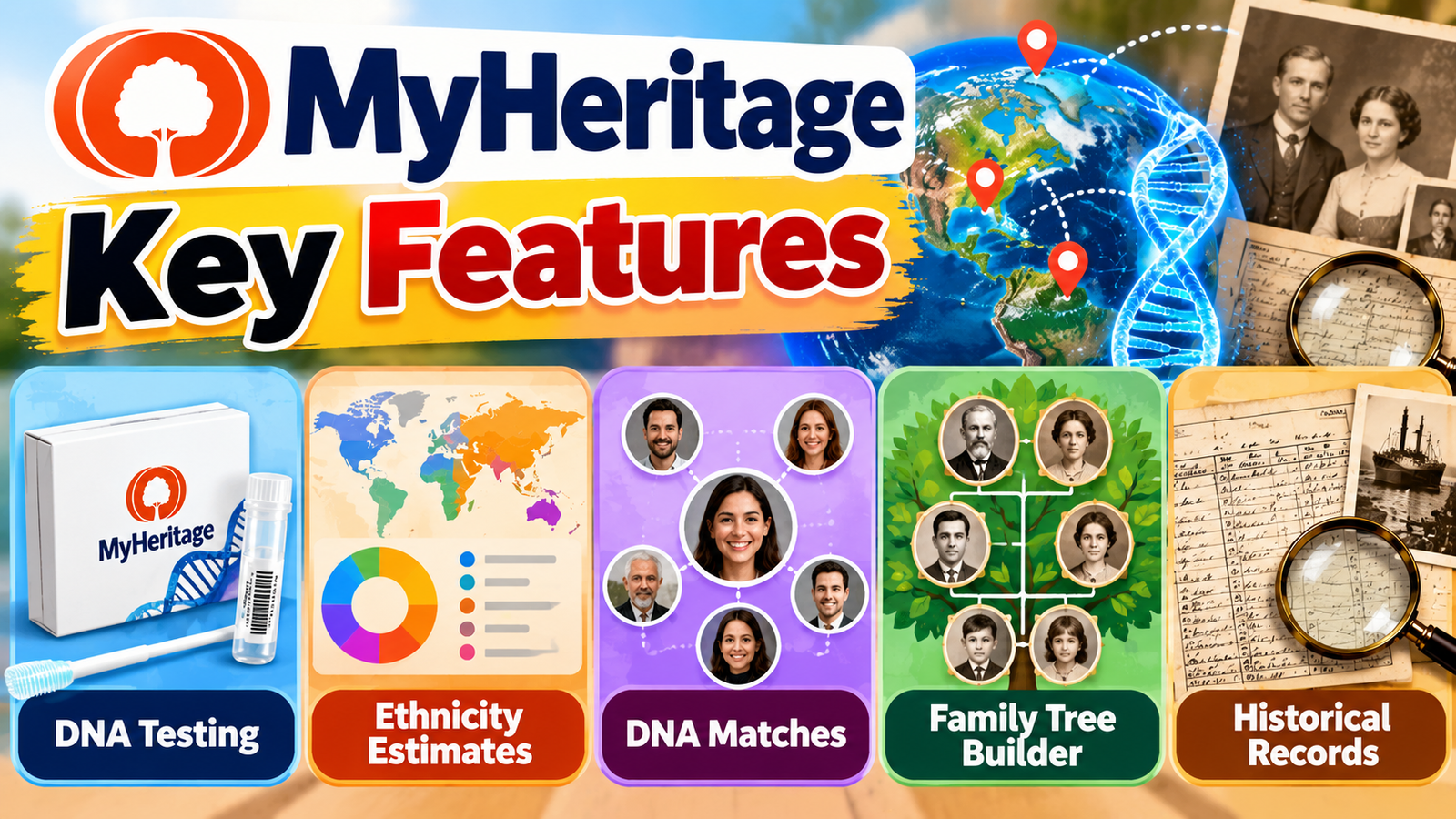
- DNA Testing: Explore genetic ancestry and discover potential biological relatives through DNA matching.
- Ethnicity Estimates: Learn about the estimated geographic origins of your DNA.
- DNA Matches: Find people who may share a common ancestor with you.
- Family Tree Builder: Create and organize a family tree with names, dates, photos, and relationships.
- Historical Records: Search available birth, marriage, death, census, and immigration records.
Building Your Family Tree
MyHeritage offers tools for creating a family tree and recording relationships between generations. You can add names, dates, photographs, locations, and other details to organize the information you discover.
A family tree provides a helpful starting point for genealogy research because it brings scattered information into one place. As you add relatives, you can compare their details with historical records and investigate possible connections.
MyHeritage may also suggest records or potential matches related to people in your tree. These suggestions can save time, but you should verify important details before accepting them. Two people with similar names are not necessarily the same person.
If you are new to genealogy, begin with information you already know about your parents, grandparents, and great-grandparents. Then expand your research gradually using documents and reliable family sources.
Understanding MyHeritage Subscriptions
MyHeritage offers different subscription options for users who want to access additional genealogy tools. The right plan depends on whether you primarily want to build a family tree, search historical records, or investigate DNA matches.
A basic account can be useful for getting started, but some advanced features require payment. For example, access to certain historical records, larger family tree capabilities, and advanced DNA analysis tools may depend on the subscription you choose.
Before you subscribe, figure out which features you truly need. If you only want to take a DNA test and review your ethnicity estimate, a comprehensive annual plan may be unnecessary. On the other hand, if you intend to spend months researching several generations, a paid plan may offer better value.
Comparing the Main Subscription Options
The following table summarizes the general purpose of MyHeritage’s main plan categories. Exact benefits depend on the current offer and subscription terms.
Plan or option | Best suited for | What to consider |
Free account | Beginners exploring family trees | Some features and records are limited |
Premium | Users developing a larger family tree | Check tree limits and included tools |
PremiumPlus | Users who need additional family tree features | Compare the extra benefits with the price |
Data subscription | People researching historical documents | Check record access and regional coverage |
Complete | Users who want a broader genealogy toolkit | Review the included features and renewal cost |
DNA kit | People interested in genetic ancestry | Check shipping, processing, and regional availability |
How Does MyHeritage Work?
MyHeritage combines DNA testing with online genealogy tools to help people explore their family history. Users can create a family tree, search historical records, and discover potential relatives through DNA matching. The platform also provides suggestions that may help users find new information about their ancestors.
Getting started is simple. Create an account, add the family information you already know, and explore the available research tools. If you purchase a DNA kit, follow the instructions to submit your sample and receive your results. Combining these results with family documents can help you build a clearer picture of your ancestry.
Who Should Use MyHeritage?
MyHeritage can be useful for people with different family history goals. Beginners can use its family tree tools to organize information about parents, grandparents, and earlier generations. People who already have a family tree can search for additional records and investigate possible connections with other researchers.
The platform may also appeal to people who have limited information about their biological relatives. DNA matching can reveal potential family connections that might otherwise be difficult to discover. However, results depend on the available DNA database and the information shared by other users.
MyHeritage may be less useful for someone who only wants a simple family tree without paid features. Before purchasing a DNA kit or subscription, consider your research goals and the features you expect to use.
Tips for Getting Better Results from MyHeritage
To make the most of MyHeritage, begin by collecting accurate information about your family. Ask relatives about their parents, grandparents, birthplaces, and important family events. Old photographs, letters, certificates, and other documents can provide valuable clues.
Next, enter the information into your family tree and compare it with available historical records. Check names, dates, and locations carefully because different people can share similar details. Avoid accepting suggested family connections without verifying the supporting evidence.
If you use DNA testing, review your matches alongside your family tree. A genetic match may help identify a relationship, but additional research is often needed to understand exactly how two people are connected.
Understanding MyHeritage DNA Matching
One of the most interesting features of MyHeritage is its DNA matching system, which helps users discover people who may share a common ancestor. After your DNA results become available, the platform compares your genetic information with other participating users. The results may reveal connections with distant cousins, previously unknown relatives, or people who are researching the same family lines.
DNA matches can be especially helpful when you have limited information about earlier generations. For example, a match with a shared family surname may provide a useful starting point for further investigation. However, surnames alone cannot confirm a relationship, and the same surname may belong to unrelated families. Compare shared DNA information with family trees, historical documents, and other evidence before drawing conclusions.
How to Use MyHeritage Historical Records Effectively
Historical records can help turn basic family information into a more detailed family history. MyHeritage provides access to various record collections, depending on the location, historical period, and subscription. These documents may help you investigate birth dates, marriage details, migration history, and other important family events.
Start your search with the person’s full name and an approximate date or location. If you do not find a match immediately, try alternative spellings or search for other family members. Historical documents sometimes contain spelling mistakes, incomplete information, or dates that differ from those recorded in family stories.
Pros and Cons of MyHeritage
MyHeritage offers several useful features, but it may not be the ideal choice for every genealogy researcher.
Pros | Cons |
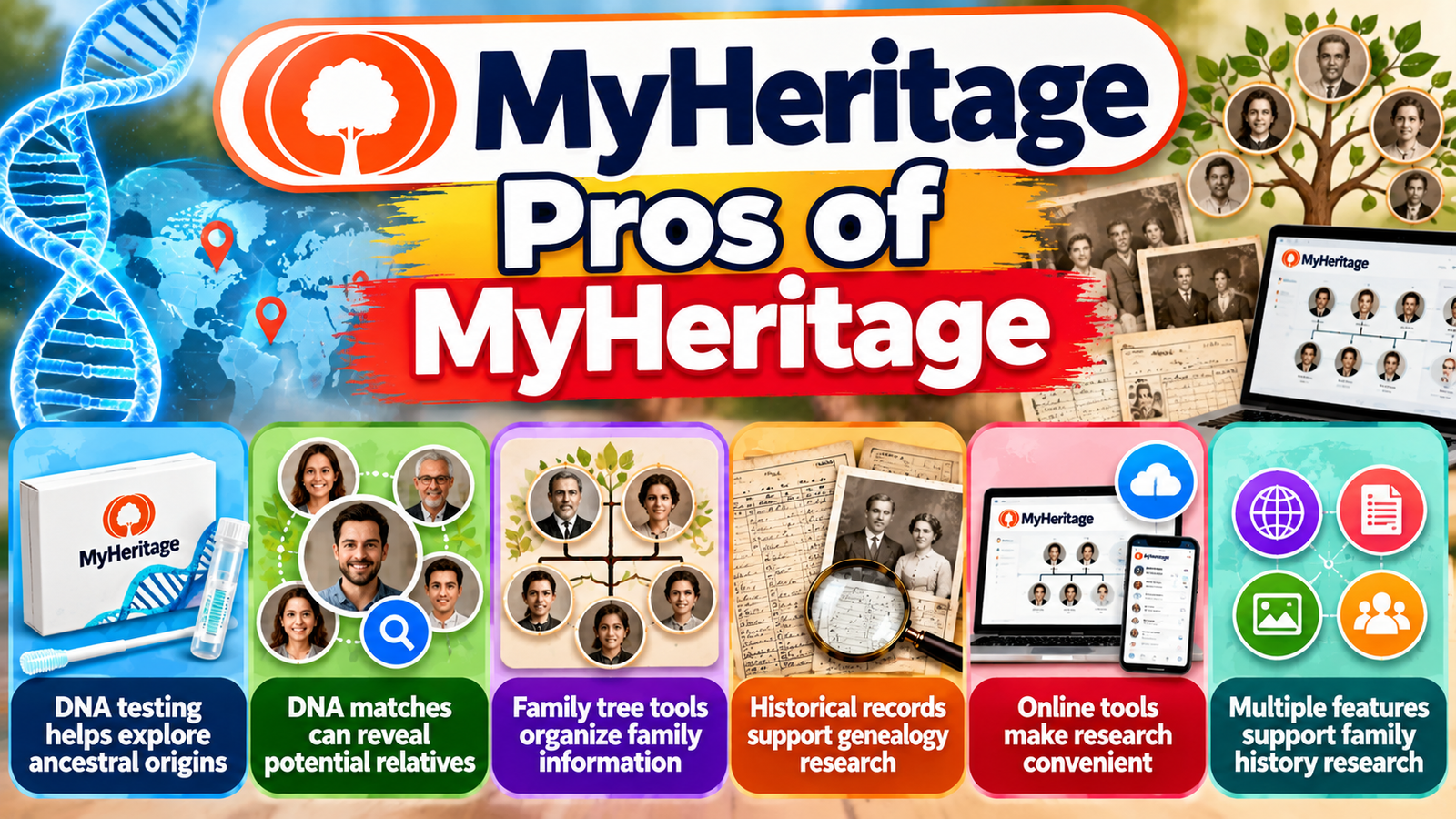
DNA testing helps explore ancestral origins | Ethnicity estimates are not exact |
DNA matches can reveal potential relatives | Matches depend on available DNA data |
Family tree tools organize family information | Advanced features may require payment |
Historical records support genealogy research | Record coverage varies by region |
Online tools make research convenient | Subscriptions can renew automatically |
Multiple features support family history research | Some users may need time to learn the tools |
The biggest advantage is the ability to combine DNA analysis with traditional genealogy research. The main drawback is that accessing the full range of features can become expensive if you need multiple paid services.
MyHeritage Pricing and Free Trials
Pricing is an important factor when choosing MyHeritage. The total cost may include the DNA kit, shipping, an optional subscription, and future renewals.
Some offers combine a DNA kit with a free trial of a paid subscription. These promotions can provide access to additional features, but you should carefully check the trial length, renewal date, and amount charged after the trial ends.
Do not assume that purchasing a DNA kit automatically provides unlimited access to historical records or every advanced genealogy feature. The kit and subscription can have different terms.
For the most accurate price, check the official website for your country and currency. Read the checkout page carefully before confirming payment, particularly if the offer includes automatic renewal.
DNA Privacy and Security
DNA testing involves personal information, so privacy deserves careful attention. Your genetic data may reveal information about your biological relatives as well as your own ancestry.
Before taking the test, review MyHeritage’s current privacy policy and DNA consent options. Understand how your sample and genetic information are handled, how DNA matching works, and what choices are available for controlling your participation.
MyHeritage provides settings for enabling or disabling DNA matching. Disabling matching means you will not receive DNA matches through that feature, so consider the consequences before changing the setting.
You should also think about the possibility of discovering unexpected family relationships. DNA testing can sometimes reveal unknown relatives or information that differs from family stories. Discussing these possibilities with family members before testing can help everyone make an informed decision.
Also Read
Discover the Latest Developments and Updates About Bellway in 2026
Comparing Popular Brands and Features to Find the Best Dip Devices
An In-Depth Look at R+R Medicinals CBD: Product Range, Quality, and Value
Top Reasons to Try Bubble Skincare for Your Daily Beauty Routine
Why The Phoenix Continues to Inspire People Around the World
Tips for Choosing the Right Plan
Choosing the right MyHeritage plan becomes easier when you start with a clear goal.
If you are mainly interested in discovering your ancestry, begin by reviewing the DNA test’s features and total purchase cost. If your goal is to trace several generations, check whether the available historical records cover your family’s countries and regions.
For people building a large family tree, compare the limits and features of the available subscriptions. Consider how often you will use the platform and whether the additional tools justify the recurring cost.
It is also helpful to prepare before subscribing. Gather family names, birth dates, marriage information, photographs, and any documents already available. Having this information ready can make your research more productive and help you evaluate whether a paid subscription is worthwhile.
Is MyHeritage Worth Buying?
MyHeritage can be a useful choice for people who want to explore their ancestry, find potential relatives, and organize family history information in one place.
Its DNA test is most valuable when used alongside historical records and family research. The family tree tools can help organize discoveries, while DNA matches may provide new leads when traditional research reaches a dead end.
However, the platform’s value depends on your needs, the availability of relevant records, and your willingness to pay for additional features. Someone who only wants an ethnicity estimate may need fewer services than a researcher investigating several generations.
Common Mistakes to Avoid When Using MyHeritage
Family history research requires patience and attention to detail. One common mistake is accepting every automated suggestion without checking whether the information is correct. Similar names, approximate dates, and incomplete documents can sometimes lead to incorrect family connections.
Another mistake is treating DNA ethnicity estimates as exact proof of nationality. Genetic ancestry estimates provide information about similarities to reference populations, but they do not establish citizenship or identify every ancestor’s birthplace.
Conclusion
MyHeritage is worth considering if you want to combine DNA testing, historical records, and family tree research.The platform provides useful tools for discovering ancestral origins and investigating family connections, but not every feature is included in every plan.
Compare the available subscriptions, check the records relevant to your family, and understand the renewal terms before purchasing. With a clear research goal, you can make a more informed decision about whether MyHeritage is the right investment for your family history journey.
Frequently Asked Questions
It can be worthwhile if you want to explore your ancestry, discover potential biological relatives, or support family history research. Its value depends on your research goals and the availability of relevant DNA matches.
Not every feature requires a paid subscription. You can create an account and access certain basic features, but some historical records and advanced tools require payment.
The estimate is based on comparisons with reference populations, but it is not an exact measurement of your nationality or complete ancestry. Results may change as the company's methods and reference data improve.
Yes. Its DNA matching system compares genetic information to identify people who may share ancestors with you. The relationship estimates are helpful clues, but additional research may be needed to confirm the connection.
Cancellation depends on the terms of your subscription and purchase method. Review your account's subscription settings and the applicable terms to understand how to cancel and whether any further charges may apply.
Table of Contents
Related Post

Discover the Latest Developments and Updates About Bellway in 2026
admin
October 27, 2026
Read More »


Comparing Popular Brands and Features to Find the Best Dip Devices
admin
October 26, 2026
Read More »

Key Features to Explore When Learning About Revopoint 3D Technologies Inc
admin
October 25, 2026
Read More »

Which IGK Hair Products Are Best for Frizz Control, Volume, and Shine?
admin
October 25, 2026
Read More »