

Comparexpert
Comparison Between Company


Comparing Popular IQAir Air Purifiers for Different Home Environments
Explore the best IQAir air purifiers for different home environments in this guide. Compare popular models, key features, filtration systems, maintenance costs, and room coverage to find the right IQAir air purifier for your home, lifestyle, and indoor air quality needs.
Table of Contents
Introduction
Indoor air quality can affect comfort, sleep, and everyday well-being. Dust, pollen, pet dander, smoke, and cooking odors can all make your home feel less fresh. Choosing the right air purifier can help reduce these pollutants, but the best model depends on your room size and the type of pollution you want to control.
IQAir air purifiers are known for advanced filtration systems designed to capture fine airborne particles. Some models also use specialized filters to reduce gases and odors. For example, the IQAir HealthPro 250 combines HyperHEPA particle filtration with a V5-Cell gas and odor filter, and its Indian product listing gives coverage of up to 1,125 square feet under the manufacturer’s stated conditions.
In this guide, we compare popular IQAir models and explain which home environments they may suit best. We will also look at room size, filtration, maintenance, and practical buying considerations so you can make an informed choice.
Understanding IQAir Air Purifiers
IQAir offers different air purifiers for different needs. Some focus on reducing airborne particles, while others are designed to address gases, chemicals, and strong odors. Understanding these differences is more useful than choosing a model based on its price or appearance alone.
How IQAir Filtration Works
Many IQAir room purifiers use multiple filtration stages. A pre-filter captures larger particles, helping protect the main filter. A high-efficiency particle filter captures fine airborne material, while compatible gas filters use activated carbon and other media to target selected gases and odors. The exact filter arrangement varies by model, so check the specifications before buying.
Air purifiers work best when their capacity matches the room. A unit designed for a large space may be unnecessary for a small bedroom, while a compact purifier may struggle to clean a large open-plan living area quickly. Room layout, ceiling height, outdoor pollution, and fan speed can also affect results.
Popular IQAir Air Purifier Models
The following models serve different needs. Specifications and availability can vary by market.
1. IQAir HealthPro 250 (HealthPro Plus)
The HealthPro 250 is a strong option for households concerned about fine particles, dust, pollen, and certain gases and odors. Its three-stage filtration system combines a pre-filter, HyperHEPA filter, and V5-Cell gas and odor filter. IQAir lists coverage of up to 1,125 square feet, although actual cleaning performance depends on room conditions and the desired air-cleaning rate.
Its main advantage is the combination of particle and gas filtration in one unit. This can be useful in homes affected by outdoor pollution, seasonal allergens, or everyday household odors. However, it is a substantial appliance, and replacement filters add to the long-term cost. If you are buying in India, check the current local price, plug type, warranty, and availability of genuine replacement filters before ordering.
2. IQAir HealthPro 100
The HealthPro 100, also marketed in some markets as the HealthPro Compact, is worth considering when you mainly want to reduce airborne particles. The model’s standard configuration does not include a gas and odor filter and is not upgradeable with the V5-Cell filter, according to IQAir’s published series specifications.
This makes it important to match the model to your needs. It may suit a bedroom, study, or smaller living area where dust and pollen are the main concerns. If cooking fumes, chemical odors, or gases are a major issue, choose a model with a suitable gas filtration stage instead.
3. IQAir GC Series
The GC Series is designed around particle filtration and replaceable gas-filter cartridges. IQAir lists options such as MultiGas, VOC, ChemiSorber, AM, and AcidPro, each intended for different contaminant categories.
The GC Series may be worth investigating if your household has a particular concern, such as persistent odors or certain airborne chemicals. The correct cartridge matters because different filter media target different substances. Before choosing one, identify the likely source of the problem and confirm that the selected filter is suitable for it. An air purifier should not replace fixing the source of a gas leak, dampness, or other serious indoor air problem.
4. IQAir Atem Series
The Atem range includes personal-space products intended for use in settings such as desks or other individual areas, depending on the model. It may appeal to someone who wants a smaller, more targeted solution rather than a large floor-standing purifier.
A personal purifier is not automatically a replacement for cleaning the air throughout an entire room. Check the exact Atem model’s coverage, filtration, power requirements, and intended placement. For a large bedroom or living room, a room-sized purifier may be a better fit.
Key Features of IQAir
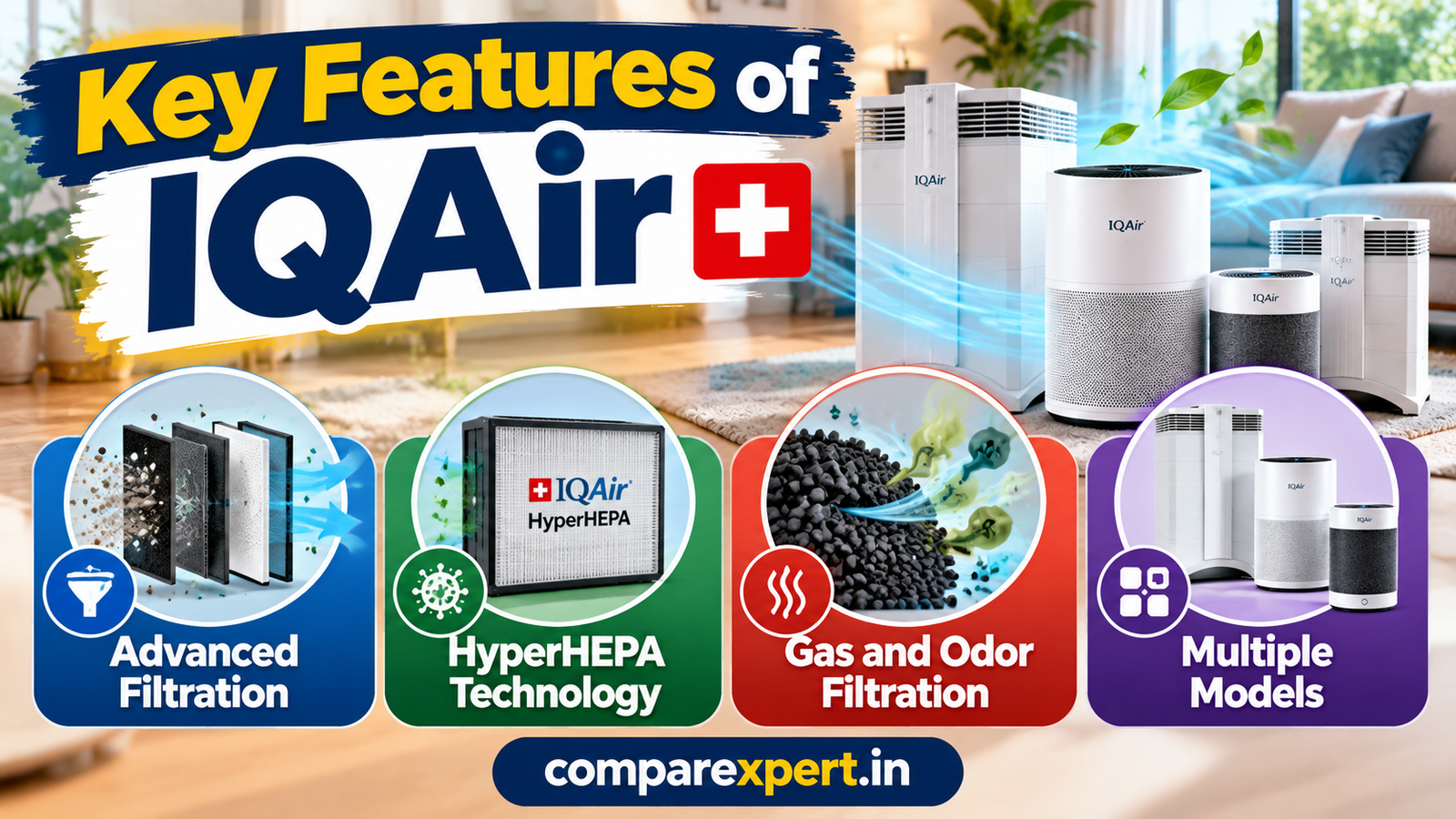
– Advanced Filtration: IQAir air purifiers use advanced filtration systems to capture fine airborne particles, including dust, pollen, and other pollutants.
– HyperHEPA Technology: Selected IQAir models feature HyperHEPA filtration designed to capture very small airborne particles.
– Gas and Odor Filtration: Certain models use specialized filter media to help reduce selected gases, chemicals, and unpleasant odors.
– Multiple Models: IQAir offers different purifiers for bedrooms, living rooms, personal spaces, and larger open areas.
Choosing a Purifier for Different Rooms
Living Rooms and Open Spaces
Living rooms often need greater air-cleaning capacity because they may connect to dining areas, hallways, or kitchens. The HealthPro 250 is a sensible model to investigate for larger rooms, particularly when both particles and odors matter. Measure the area you actually want to clean and consider whether open doorways make the effective space larger than the room itself.
Bedrooms and Small Rooms
For bedrooms, think about both cleaning performance and noise. A purifier that runs quietly at a lower setting may be more comfortable overnight, but lower fan speeds can also reduce the amount of air cleaned. A smaller HealthPro model may suit a compact room, while a HealthPro 250 could be appropriate if the room is larger or the pollution load is high. Always compare the exact model’s sound levels and room-cleaning performance before buying.
Homes With Pets
Pet owners often deal with dander, loose hair, and odors. A suitable particle filter can help reduce airborne dander, while a gas and odor filter may help with some smells. The HealthPro 250 offers both types of filtration, making it a useful option to compare for pet-friendly homes. Regular vacuuming, washing pet bedding, and cleaning surfaces remain important because an air purifier cannot remove material that has already settled on furniture or floors.
Homes in Areas With Outdoor Pollution
When outdoor air contains substantial dust or fine particles, a purifier with effective particle filtration can help improve indoor air quality. Keep windows and exterior doors closed when outdoor conditions are poor, where practical, and ventilate when conditions allow. For a larger room, check the purifier’s airflow and recommended coverage rather than relying on the brand name alone.
Large Open-Plan Homes
For large living spaces, the IQAir Atem X is another model to consider. IQAir lists coverage of up to 1,650 square feet and describes it as a purifier for large shared spaces. Its design focuses on particle filtration, including fine and ultrafine particles.
It may be suitable for a spacious living room or open-plan apartment. However, advertised coverage depends on the conditions used to calculate it. If you need rapid cleaning during periods of heavy pollution, compare airflow and air changes per hour rather than choosing solely by the maximum square-foot figure.
Comparing IQAir Air Purifiers
Model | Best suited for | Main strength | Key consideration |
HealthPro 250 | Medium to large rooms | Particle, gas, and odor filtration | Higher purchase and filter costs |
HealthPro 100 / Compact | Smaller rooms | Particle filtration | No standard gas and odor filter |
GC Series | Homes with specific chemical or odor concerns | Specialized gas-filter options | Select the correct cartridge |
Atem Desk | Desks and personal spaces | Compact, targeted air cleaning | Limited room coverage |
Atem X | Large open spaces | High airflow and particle filtration | Check gas-filter needs separately |
IQAir Air Purifiers for Allergy-Prone Households
Dust, pollen, and pet dander can become airborne during everyday activities, including cleaning, walking across carpets, and handling bedding. A suitable IQAir purifier can capture some of these airborne particles and help reduce their concentration indoors. Models with HyperHEPA filtration may be worth comparing if fine particles are your main concern.
However, an air purifier is only one part of managing indoor allergens. Regular vacuuming, washing bedding, controlling indoor humidity, and reducing dust accumulation can also help. Choose a purifier based on your room size and filtration needs rather than assuming that every model offers identical protection.
IQAir vs. Other Air Purifiers: What Makes It Different?
When comparing IQAir with other air purifier brands, consider filtration performance, room coverage, noise levels, and long-term costs. IQAir’s HealthPro series combines particle filtration with gas and odor filtration in selected models, while its Atem range includes options for personal spaces and larger rooms.
The best choice depends on your requirements rather than the brand name alone. Some households may benefit from advanced multi-stage filtration, while others may prefer a simpler, more affordable purifier for a small bedroom. Always compare verified specifications and replacement-filter costs before making your decision.
How to Maintain Your IQAir Air Purifier
Regular maintenance helps your IQAir air purifier continue working effectively. Follow the manufacturer’s instructions for cleaning the exterior, keeping air inlets clear, and checking filter-life indicators where available. Avoid washing or reusing filters unless the manual specifically permits it.
Filter life varies according to fan speed, daily operating hours, and pollution levels. For example, IQAir estimates that the HealthPro 250’s pre-filter may last around 12–18 months, while its main HyperHEPA filter may last approximately 36–48 months under specified usage conditions.
Common Mistakes to Avoid When Buying an IQAir Purifier
One common mistake is choosing a purifier based only on its advertised room coverage. A large room with heavy pollution may need a higher cleaning rate than a smaller room with fewer pollutants. Room layout, ceiling height, and operating speed also affect performance.
Another mistake is overlooking gas filtration. Particle filters and gas filters perform different jobs, so a model that captures dust effectively may not be the best choice for persistent chemical odors. Finally, remember to include replacement filters and electricity in your budget.
Benefits of Using IQAir Air Purifiers at Home
An IQAir air purifier can help improve indoor air quality by reducing airborne particles such as dust, pollen, and other pollutants. Selected models also include specialized filters designed to reduce certain gases and odors. This makes IQAir worth considering for households with different air-quality concerns, from everyday dust to outdoor pollution entering through windows and doors.
The main benefit is the range of filtration options available. Rather than offering the same solution for every home, IQAir provides models for personal spaces, bedrooms, and larger rooms. Choosing the right model can help you balance filtration performance, noise, space requirements, and maintenance costs.
Smart Features and Air-Quality Monitoring
Some IQAir products and related AirVisual devices offer air-quality monitoring and digital controls. Depending on the product, these features can help users track particulate levels, review air-quality information, or adjust settings more conveniently.
Air-quality monitoring can be useful when outdoor pollution changes throughout the day or when you want to understand how cooking and cleaning affect indoor air. However, monitoring features vary between products, and not every IQAir purifier includes the same sensors or connectivity. Check the exact model’s specifications before purchasing.
IQAir Air Purifiers for Homes With Children
Families may want to reduce exposure to airborne dust, pollen, and other particles in bedrooms and shared spaces. An IQAir model with suitable particle filtration may help lower airborne particle levels when correctly sized and operated. Place the unit on a stable surface, keep its air outlets unobstructed, and position cords safely away from children.
Choose a model based on the room’s size and the noise level you can comfortably tolerate. Avoid making medical claims about air purifiers: cleaner indoor air may support a healthier environment, but a purifier does not prevent or cure every respiratory condition.
Also Read
What Makes Waterdrop (US) Different? A Guide to Its Products and Benefits
A Complete Guide to Business Envelopes, Sizes, and Designs with Envelopes.Com
Everything You Need to Know About Breeze Before Choosing It
What You Should Know About AKKO Before Protecting Your Gadgets
A Beginner’s Guide to VirtualPBX and Cloud-Based Phone Systems
Seasonal Air Pollution and IQAir Performance
Air quality can change with the seasons. Dry weather may increase dust, pollen can rise during certain periods, and smoke or pollution may become more noticeable during other parts of the year. Selecting an appropriate IQAir purifier can help you respond to these changing conditions indoors.
During periods of high pollution, consider running the purifier consistently at a suitable setting and monitoring indoor air quality if you have a compatible device. Keep windows closed when outdoor conditions are poor, where practical, and maintain the filters according to the manufacturer’s instructions.
Comparing Costs and Maintenance
An air purifier’s purchase price is only part of its total cost. You should also consider replacement filters, electricity use, warranty coverage, and the availability of genuine parts. A model with a lower initial price may cost more over time if its filters are expensive or difficult to obtain.
For example, IQAir’s Indian website lists the HealthPro 250 at approximately ₹144,700 and the Atem Desk at approximately ₹51,000 in the retrieved listings. These are indicative listed prices, not guaranteed current offers, and may change by configuration or seller.
Filter life also depends on how often you run the purifier and how polluted the air is. IQAir’s HealthPro 250 specifications estimate approximately 12–18 months for the pre-filter, 15–21 months for the gas filter, and 36–48 months for the main particle filter under stated usage conditions. The Atem Desk’s published specifications estimate about one year for its filter.
Tips for Choosing the Right IQAir Model
Start by identifying the main problem in your home. If dust, pollen, and fine particles are your biggest concerns, prioritize particle filtration and sufficient airflow. If chemical odors or gases are a concern, choose a model with a suitable gas filtration system rather than assuming every IQAir purifier offers the same protection.
Next, measure your room and consider how it connects to other areas. A purifier rated for a closed bedroom may not clean a large living room and kitchen equally well. Also consider noise, electricity use, available floor space, and whether you want app-based controls.
Conclusion
The best IQAir air purifier depends on your home environment. The HealthPro 250 is a strong all-round option for medium to large rooms where both particles and odors matter. The HealthPro 100 is worth considering for particle filtration in smaller spaces, while the GC Series is designed for more specific gas and chemical filtration needs. For personal spaces, the Atem Desk offers a compact option, and the Atem X is designed for larger open areas.
Before making a decision, compare room coverage, filter replacement costs, noise, and the pollutants you want to target. The right choice is the one that fits your home and can be maintained properly over time.
Frequently Asked Questions
The HealthPro 250 and Atem X are worth comparing. The best choice depends on the room size, desired cleaning rate, and whether you need gas and odor filtration as well as particle filtration.
Yes. Models with effective particle filtration can help reduce airborne pet dander. A model with
It depends on the model, usage, and pollution level. Some filters may last around a year, while certain HealthPro filters have longer estimated lifespans. Follow the manufacturer's recommendations for your specific unit.
Models with suitable gas and odor filters, such as the HealthPro 250 or relevant GC Series models, can help reduce some cooking odors. Ventilation and an effective kitchen exhaust hood are still important.
They may be worth considering if you need advanced filtration and can manage the purchase and replacement-filter costs. Compare the features you actually need, the room coverage, and long-term maintenance before deciding.
Table of Contents
Related Post
What Makes Waterdrop (US) Different? A Guide to Its Products and Benefits
admin
October 16, 2026
Read More »

How Does Uber Eats Global Delivery Work Across Different Countries?
admin
October 15, 2026
Read More »

A Beginner’s Guide to Convenient Grocery Shopping with Walmart Online Grocery
admin
October 14, 2026
Read More »

A Complete Guide to Business Envelopes, Sizes, and Designs with Envelopes.Com
admin
October 14, 2026
Read More »

How to Choose Premium Knitwear and Cashmere Clothing from Gentle Herd
admin
October 13, 2026
Read More »