

Comparexpert
Comparison Between Company


Lasting Dynamics Review: Is Lasting Dynamics a Reliable Tech Partner?

Lasting Dynamics is a software development company known for custom software, AI solutions, and product engineering services. This review explores Lasting Dynamics’ core offerings, reputation, strengths, and potential drawbacks to help businesses decide whether it is a reliable tech partner for long-term digital projects.
Table of Contents
What Is Lasting Dynamics?
Company Background and Global Presence
Lasting Dynamics positions itself as a modern software development company built for businesses that want more than just outsourced code. The company presents itself as an award-winning software house focused on building digital products across web, mobile, AI, VR/XR, and Web3. According to its public company profile, Lasting Dynamics has built its reputation around delivering custom software solutions for startups, scale-ups, and enterprise clients that need technical execution without building a large in-house engineering department. That value proposition is attractive because, let’s be honest, hiring and managing a full product team internally is expensive, slow, and often chaotic.
From a market-facing perspective, Lasting Dynamics has done a strong job branding itself as a globally distributed engineering partner. Its public-facing presence emphasizes international reach, remote collaboration, and technical specialization, which matters in 2026 when clients increasingly want flexible, globally available development teams. The company’s LinkedIn positioning highlights expertise in web, mobile, VR/XR, AI, and Web3, suggesting it wants to be seen as a future-ready engineering firm rather than just another app development agency.
That positioning matters because modern buyers are not just looking for developers anymore. They are looking for execution partners—teams that can think in terms of product, architecture, scale, and long-term maintainability. Lasting Dynamics clearly understands this shift and markets itself accordingly. On the surface, that makes it look like a compelling option for founders and businesses that need a serious technical partner rather than a low-cost freelancer shop.
Core Services asnd Technology Focus
At its core, Lasting Dynamics is built around custom digital product development. That means the company is not just selling development hours; it is selling product delivery across multiple technical layers. Its service positioning suggests a full-cycle software model, including planning, design, architecture, development, testing, and deployment. This is important because companies hiring a software partner usually do not need one isolated service. They need a team that can move from idea to production without constant hand-holding.
The company appears especially focused on projects that require more than standard CMS work or simple front-end builds. Its public messaging leans heavily into higher-value technical areas like AI systems, immersive experiences, and custom enterprise-grade software. That gives Lasting Dynamics stronger appeal among businesses building digital products with technical complexity, such as SaaS platforms, internal enterprise systems, customer-facing apps, or innovation-led prototypes.
This technical focus also helps differentiate Lasting Dynamics from generic development agencies. Plenty of agencies can build a website. Fewer can architect scalable software, deploy machine learning workflows, or manage complex product ecosystems with modern infrastructure. That difference is where Lasting Dynamics tries to win. The real question, though, is not whether the positioning is attractive. It is whether the company consistently delivers on that promise in real-world engagements.
Why Businesses Consider Lasting Dynamics
Product Engineering Capabilities
Businesses typically look at Lasting Dynamics because it presents itself as a product-first engineering company rather than a task-based outsourcing vendor. Most businesses are unaware of how important that distinction is. A task vendor builds what you ask for. A product engineering partner helps shape what should be built, how it should work, and how it should scale. Those are very different relationships, and the second one is usually far more valuable.
For companies building custom software, especially startups and digital-first brands, that product mindset is a huge advantage. It means fewer disconnected contractors, fewer translation gaps between strategy and engineering, and a tighter loop between design, product, and development. When that model works, it feels less like outsourcing and more like adding a technical division to your business.
That is the real appeal here. Lasting Dynamics is not trying to compete on cheap developer rates alone. It is trying to compete on technical ownership, product thinking, and delivery maturity. For businesses launching software products, that is often a much stronger value proposition than simply hiring cheaper developers in bulk.
Startup and Enterprise Appeal
One of the more interesting things about Lasting Dynamics is that it appears to market well to both startups and enterprise buyers. That is not easy to do. Startups want speed, flexibility, and strategic technical guidance. Enterprises want process, reliability, governance, and long-term maintainability. Those needs often pull in opposite directions.
Lasting Dynamics seems to bridge that gap by positioning itself as both agile and technically mature. For startups, it offers product development without the overhead of building an internal engineering team too early. For enterprises, it offers specialized delivery capacity without bloating internal headcount. That dual appeal is one of its strongest commercial advantages.
The challenge, of course, is execution. Serving both startups and enterprises is like trying to build race cars and cargo trucks in the same garage. It can absolutely be done, but only if operations, communication, and leadership are disciplined enough to support both models well.
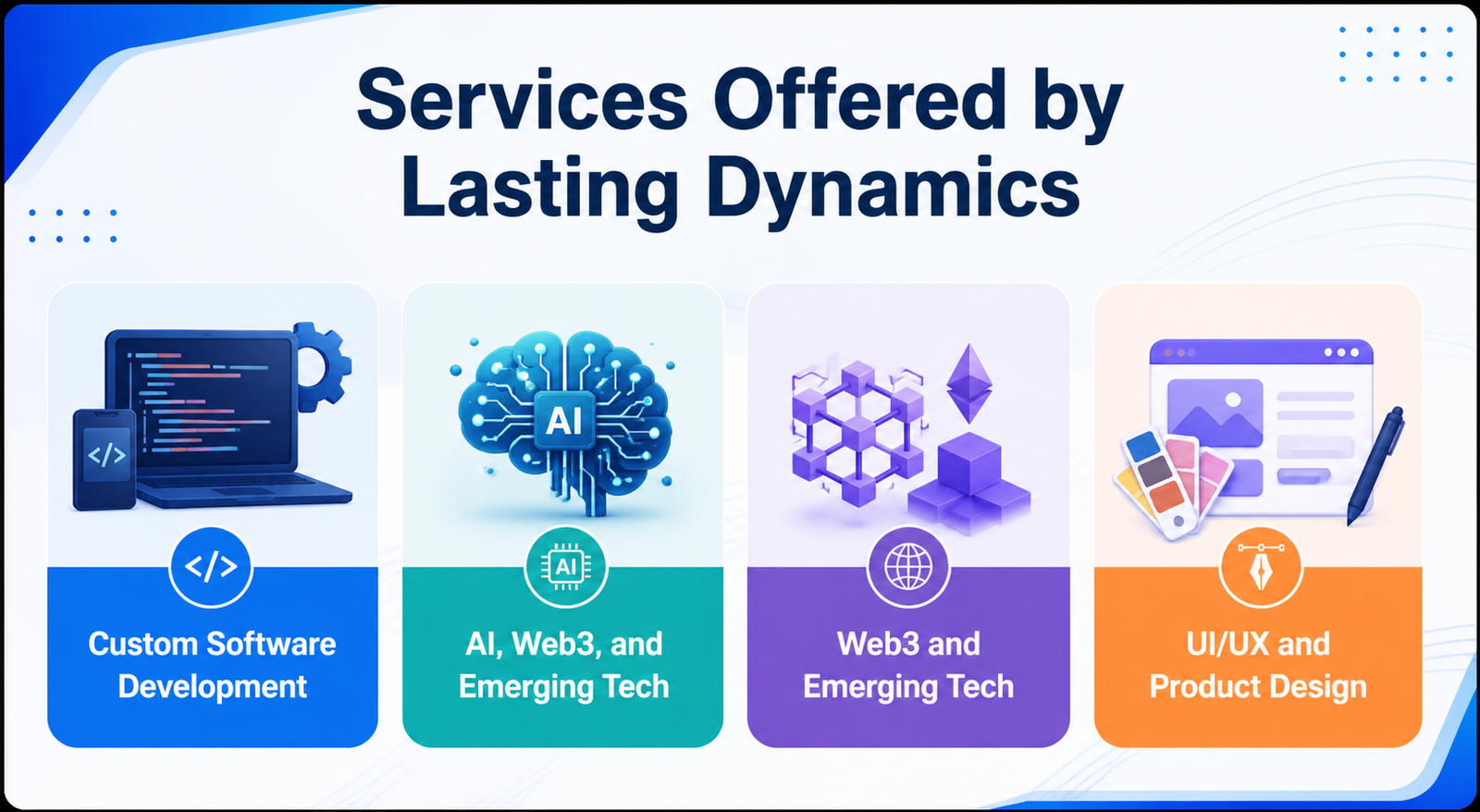
Services Offered by Lasting Dynamics
Custom Software Development
Custom software development is clearly the center of gravity for Lasting Dynamics. This is where the company appears strongest and most credible. Businesses that need tailored digital systems, whether customer-facing platforms or internal tools, are likely the best match for what Lasting Dynamics is built to do.
Its service positioning suggests a full-stack product delivery model rather than fragmented technical outsourcing. That is a major advantage for companies that want one accountable partner rather than five disconnected specialists.
AI, Web3, and Emerging Tech
Lasting Dynamics leans heavily into future-facing technologies, particularly AI, Web3, and immersive digital experiences. This can be a real strength for innovation-driven companies, especially those building differentiated digital products. It also signals that the company wants higher-value, technically ambitious work rather than low-margin commodity projects.
That said, buyers should validate actual case studies carefully. Emerging-tech positioning sounds impressive, but execution depth matters far more than buzzwords.
UI/UX and Product Design
A strong software partner is rarely just about code. Product design is where usability, conversion, and user trust are built. Lasting Dynamics appears to understand that, and its service positioning suggests design is part of the product process rather than an afterthought.
That is a good sign, especially for businesses building software where user experience directly impacts retention and revenue.
Lasting Dynamics Reputation in 2026
What Public Reviews Reveal
Public review data paints a more nuanced picture of Lasting Dynamics than its polished brand messaging suggests. On the positive side, the company has clear signals of technical credibility and a strong training culture. On the more concerning side, employee reviews raise repeated concerns around management style, internal culture, and communication.
As of 2026, Glassdoor shows Lasting Dynamics with a 3.6/5 employee rating, with 58% of employees saying they would recommend the company to a friend. That is not disastrous, but it is also not the kind of score that screams operational excellence. It places the company in a middle ground—credible enough to be taken seriously, but inconsistent enough to warrant closer scrutiny.
That middle-ground reputation is important. It suggests Lasting Dynamics is not a scam, not a shell company, and not an empty brand. It clearly delivers real work and employs real technical talent. At the same time, the public sentiment suggests that delivery quality may coexist with internal friction. For clients, that matters because internal instability often leaks into project execution, communication, and consistency over time.
Client-Facing Strengths vs Internal Concerns
This is where the real evaluation gets interesting. Lasting Dynamics appears to have a classic strong-client / mixed-internal profile. That means the company may deliver technically solid outcomes for clients while still carrying internal operational issues that create long-term risk.
Employee reviews repeatedly mention positives like technical growth, learning opportunities, code quality, and mentorship. Those are strong indicators that the engineering culture has substance. But multiple reviews also mention micromanagement, low compensation, and leadership concerns, including claims of a toxic internal environment.
That does not automatically make Lasting Dynamics a bad partner. It does mean clients should evaluate it carefully. A company can deliver strong work and still struggle internally. The risk is not whether the team can build. The risk is whether internal friction affects retention, continuity, communication, and long-term project stability.
Lasting Dynamics Pricing and Value
Cost Positioning in the Market
Lasting Dynamics appears to compete in the mid-to-premium outsourcing bracket rather than the bargain segment. That usually means clients are paying for stronger architecture, broader delivery capability, and more strategic involvement.
For businesses shopping purely on hourly cost, cheaper alternatives exist. For businesses buying outcomes, that pricing may be justified.
Is It Worth the Investment?
If you need a basic brochure website, Lasting Dynamics is likely overkill. If you need a real product team to design, build, and scale custom software, the value proposition becomes much stronger.
The company looks best suited for buyers who prioritize capability over the lowest possible rate.
Pros and Cons of Working With Lasting Dynamics
Where They Stand Out
Strength | Why It Matters |
Strong technical positioning | Better fit for complex product builds |
Product-first delivery model | More strategic than task outsourcing |
Modern tech stack focus | Useful for AI and advanced digital products |
Global delivery model | Flexible collaboration across regions |
Potential Red Flags
Concern | Why It Matters |
Mixed employee sentiment | May affect delivery continuity |
Leadership complaints | Can impact team stability |
Micromanagement concerns | Potential communication friction |
Mid-tier public reputation | Requires stronger due diligence |
Why Businesses Are Talking About Lasting Dynamics
Lasting Dynamics has become a notable name in the software development space because it positions itself as more than a typical outsourcing company. Instead of presenting itself as just another vendor offering development hours, the company markets itself as a long-term product engineering partner. That difference is one of the main reasons businesses are paying attention. In a market crowded with agencies that promise speed and low cost, Lasting Dynamics stands out by focusing on technical depth, product strategy, and scalable software development. For businesses building serious digital products, that positioning naturally creates interest.
What Lasting Dynamics Actually Offers
At its core, Lasting Dynamics focuses on custom software development for businesses that need more than basic web development. The company appears to offer full-cycle product development, including planning, design, development, testing, and long-term support. This is important because most businesses do not just need developers to write code. They need a structured team that can help shape, build, and maintain software over time. That broader service model makes Lasting Dynamics more appealing to companies that want a technical partner rather than a one-time contractor.
Where Lasting Dynamics Stands Out
One of the strongest advantages of Lasting Dynamics is its focus on product engineering instead of simple task execution. Many development agencies work like delivery shops, completing assigned tasks without thinking much about long-term product performance. Lasting Dynamics appears to take a different approach by emphasizing architecture, scalability, and long-term maintainability. That matters because software is rarely static. Products grow, features expand, and user expectations change. A company that builds with long-term scalability in mind often creates far more value than one that only focuses on short-term delivery.
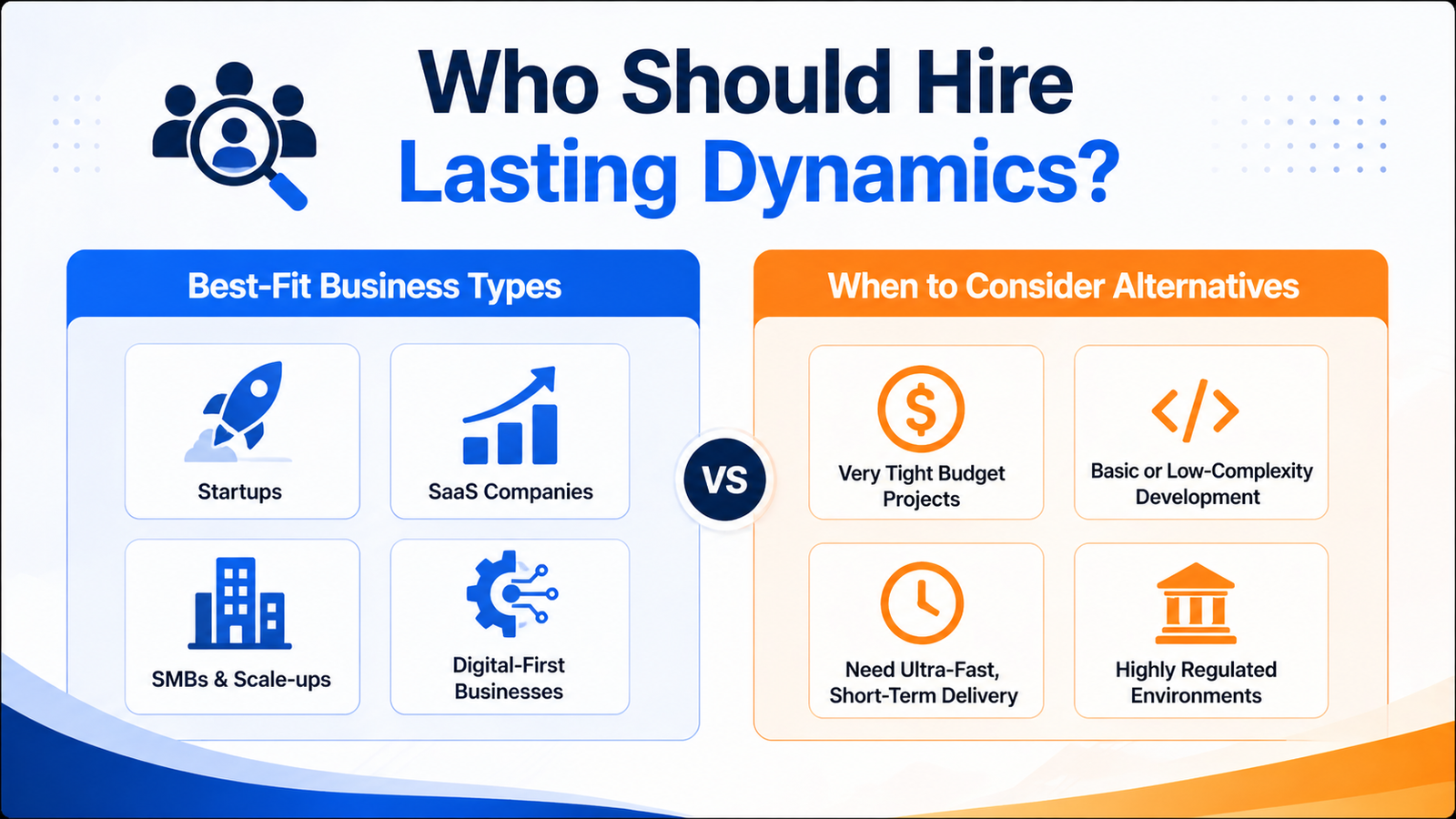
Who Should Hire Lasting Dynamics?
Best-Fit Business Types
Lasting Dynamics is best suited for startups, SaaS companies, and digital-first businesses that need serious technical execution. It is also a reasonable fit for enterprises needing external product engineering capacity.
When to Consider Alternatives
If your priority is the lowest possible cost, ultra-simple development, or highly stable enterprise procurement with zero culture risk, other vendors may be safer.
Is Lasting Dynamics Good for Startups?
For startups, Lasting Dynamics can be an attractive option because it offers access to a broader technical team without the cost of building one internally. Early-stage companies often need product design, development, technical guidance, and iteration support at the same time. Hiring separate people for all of that can be expensive and difficult to manage. A company like Lasting Dynamics may help startups move faster by bringing those capabilities together under one delivery structure. That can be especially useful for founders who need technical execution but are not ready to build a full in-house team.
Is Lasting Dynamics Reliable for Long-Term Projects?
Reliability in software development is not just about launching a product. It is about what happens after launch, when updates become more complex, user expectations increase, and technical decisions start affecting growth. This is where Lasting Dynamics becomes more relevant as a long-term partner. The company appears to position itself around long-term software thinking rather than one-off delivery. That suggests stronger potential for businesses that need ongoing development, iteration, and product support instead of a simple handoff after launch.
Also Read
Ranowear, Inc. Review: Quality, Pricing & Style
BOOX CO., LTD Review: Best eReaders and Tablets Explained
Virtual Sheet Music, Inc. Review: Best Platform for Musicians?
LELE SADOUGHI Review 2026: Is LELE SADOUGHI Worth It?
Top Benefits of Choosing Klarmobil for Your Mobile Needs
What Businesses Should Consider Before Hiring Lasting Dynamics
Before hiring Lasting Dynamics, businesses should evaluate more than just technical capability. Strong software delivery also depends on communication, project ownership, and team consistency. A technically capable partner can still become difficult to work with if internal processes are unclear or delivery expectations are not aligned. That is why businesses should assess how Lasting Dynamics handles communication, team stability, and project management before making a long-term commitment. The right technical partner should not only build well but also communicate clearly and adapt reliably.
Is Lasting Dynamics Worth It?
Whether Lasting Dynamics is worth hiring depends largely on what a business actually needs. For simple projects or low-cost development, there are cheaper alternatives. For businesses building complex digital products that require technical depth, long-term thinking, and structured execution, Lasting Dynamics may offer stronger value. The company appears best suited for businesses that care more about product quality and long-term scalability than simply finding the lowest development rate.
Conclusion
Lasting Dynamics appears to be a legitimate and technically capable software development company with real strengths in product engineering, modern technology, and custom software execution. It does not look like a low-end outsourcing shop, and it clearly has enough technical credibility to attract serious clients. That is the good news.
The more complicated answer is that Lasting Dynamics looks reliable, but not risk-free. Public signals suggest genuine engineering strength paired with internal management concerns that deserve attention. For the right client, especially one buying technical capability and product depth, Lasting Dynamics can be a strong partner. The smartest approach is simple: treat them as a serious contender, but run proper due diligence before signing.
Frequently Asked Questions
Yes, Lasting Dynamics appears to be a legitimate software development company with an established public presence, active hiring footprint, and client-facing service model.
Yes, especially for startups that need full-cycle product development without building an internal engineering team too early.
Yes, the company publicly positions AI as one of its core service areas.
Yes. Public employee reviews raise recurring concerns around management style, compensation, and internal culture.
It can be, especially for technically demanding product builds. The right fit depends on your budget, project complexity, and tolerance for vendor diligence.
Table of Contents
Related Post

Finding Student Housing and Communities With Erasmusu: A Practical Guide
admin
September 19, 2026
Read More »

What Travelers Should Know About Iberostar (closed) and Its Hotel History
admin
September 18, 2026
Read More »

Planning a European Trip? Discover the Benefits of Direct Ferries
admin
September 17, 2026
Read More »

What Makes Der Gepflegte Mann a Notable Name in Men’s Personal Care
admin
September 16, 2026
Read More »