

Comparexpert
Comparison Between Company


SainSmart Review 2026: Is SainSmart Worth Buying?

Looking for an honest SainSmart review in 2026? This guide breaks down SainSmart’s CNC machines, laser tools, build quality, pricing, and overall value to help you decide if SainSmart is worth buying for your workshop, hobby projects, or small business.
Table of Contents
What Is SainSmart and Why Is It Popular in 2026?
If you spend any time in the maker world, chances are you have already bumped into SainSmart. It is one of those brands that keeps showing up in hobby CNC forums, beginner 3D printing setups, laser engraving groups, and DIY electronics conversations. That is not an accident. In 2026, SainSmart has built a reputation as a practical, budget-conscious brand that gives hobbyists and small workshop owners access to tools that used to feel expensive and intimidating. Instead of trying to compete with industrial giants head-on, SainSmart has carved out its own lane by making maker tools more approachable, more affordable, and much less scary for beginners.
What makes the brand so popular is simple: it understands its audience. SainSmart does not sell machines for giant production floors or aerospace factories. It sells tools for makers, tinkerers, students, side hustlers, and small businesses that need capable machines without burning through their budget. Its Genmitsu CNC line, in particular, has become the face of affordable desktop CNC. That popularity has only grown because the company has stayed focused on the same promise—give people decent hardware, enough support to get started, and a clear upgrade path when they outgrow the beginner stage. In a market crowded with cheap clones and overpriced premium tools, that balance is exactly why SainSmart still matters in 2026.
SainSmart’s Core Product Categories
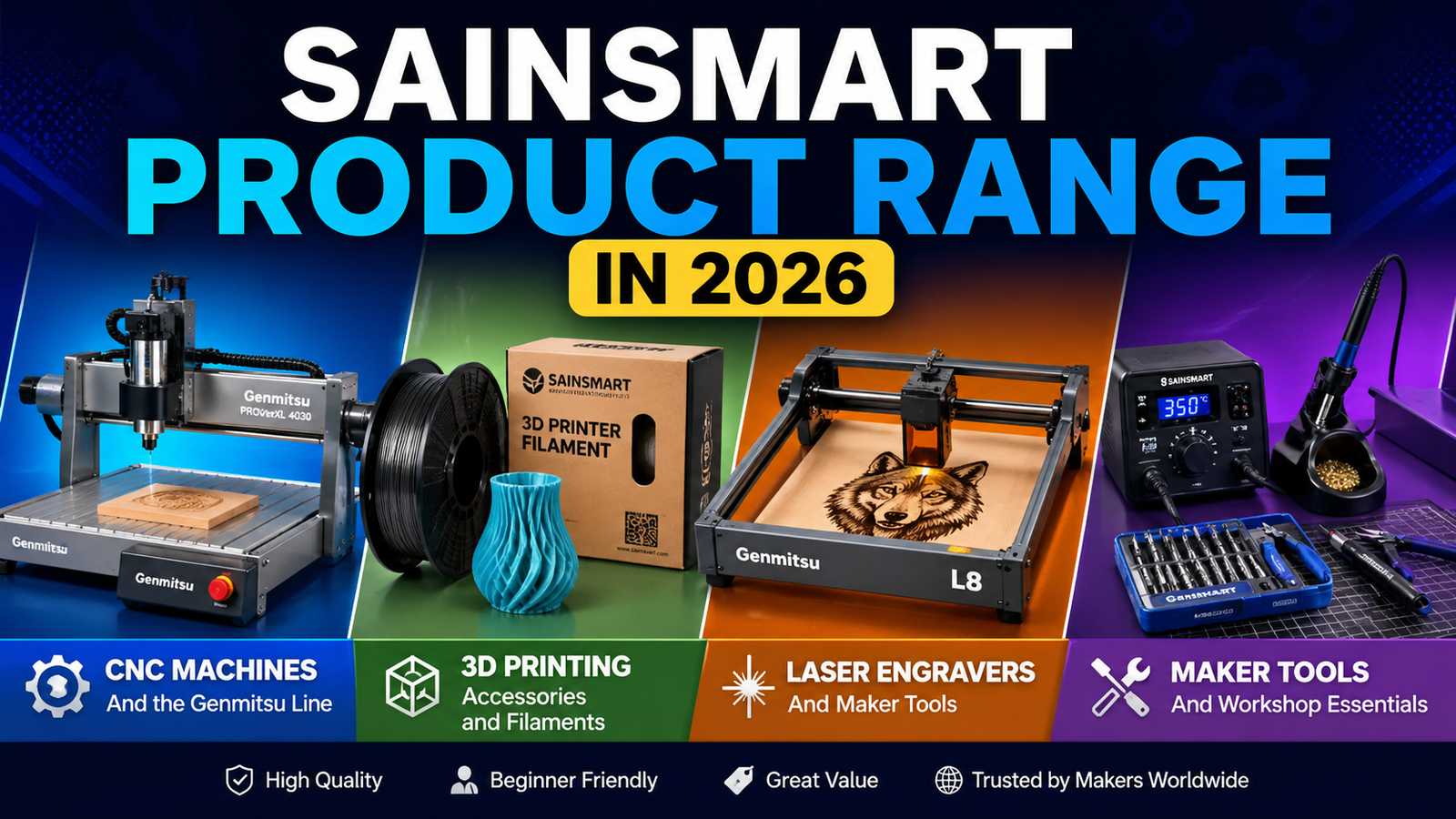
SainSmart’s catalog in 2026 is no longer just about hobby electronics. The company now spreads across several maker-focused categories, and that wider ecosystem is part of its appeal. Its most recognized products still live in desktop CNC machines, especially the Genmitsu line, but that is only one piece of the puzzle. The company also sells 3D printer filament, laser engravers, CNC accessories, replacement parts, spindles, controllers, and workshop add-ons. That makes SainSmart feel less like a one-product brand and more like a workshop ecosystem.
This matters more than it sounds. A lot of cheaper tool brands sell you the machine and disappear. SainSmart, by contrast, has built a more complete path around the machine. Need a replacement spindle? They sell it. Want a laser upgrade for your CNC? It is already in the ecosystem. Need upgraded rails, bits, or expansion kits? Those exist too. That level of continuity gives buyers confidence, especially beginners who do not want to get stranded with a dead machine and no parts. It also means SainSmart is not just selling tools—it is selling a platform for makers who plan to keep building.
Who Typically Buys SainSmart Products?
SainSmart has a very specific audience, and understanding that audience is the key to understanding whether the brand is worth your money. The typical buyer is not a factory manager. It is someone building in a garage, workshop, spare room, or classroom. Think hobby woodworkers, electronics students, Etsy sellers, prototype builders, engineering learners, and side-hustle creators. These are people who want practical tools, not industrial monsters.
That is where SainSmart fits so well. A beginner can buy a compact Genmitsu machine, learn the basics of toolpaths and feeds, and actually make useful things without spending thousands. A small business owner can use a larger PROVerXL machine for signage, engraving, and light production work. A student can use one to learn CAD/CAM without needing access to an expensive industrial lab. SainSmart works because it lives in that sweet spot between “toy” and “serious machine.” It is not pretending to be industrial-grade. It is trying to be useful, upgradeable, and realistic for the people who actually buy desktop tools.
SainSmart Product Range in 2026
SainSmart’s product range in 2026 is broad enough that calling it just a CNC brand feels incomplete. The company now sits comfortably in the maker-tool ecosystem, with products spanning CNC routers, laser engravers, 3D printing materials, and workshop accessories. That range matters because it gives buyers room to grow. Many users start with one entry-level machine, learn the ropes, and later move deeper into the same ecosystem without needing to switch brands. That kind of continuity is a big reason SainSmart has stayed relevant while many budget tool brands fade after a single product cycle.
The strongest part of SainSmart’s lineup is still how clearly segmented it is. Beginners get affordable, compact options. Intermediate users get stronger frames and better spindles. Advanced hobbyists and small businesses can step into larger, more rigid machines built for more serious work. This tiered approach makes SainSmart easy to understand. You do not need to decode confusing model names and vague promises. You can usually tell exactly who a machine is for just by where it sits in the lineup, and that clarity makes shopping much easier.
CNC Machines and the Genmitsu Line
The Genmitsu line is SainSmart’s crown jewel. It is the product family most buyers know, and it is the biggest reason the brand gets recommended so often in CNC communities. Entry-level models like the 3018-PROVer V2 remain popular because they are affordable, compact, and beginner-friendly. According to SainSmart’s own ecosystem breakdown, entry-level CNCs typically sit around $150 to $300, mid-range machines around $300 to $600, and larger-format or more advanced systems stretch from $600 to $1,500+. That price ladder gives users a clear upgrade path without forcing them into industrial pricing.
What makes Genmitsu stand out is not raw power. It is the balance between cost, usability, and upgrade potential. The 3018 models are ideal for learning, PCB milling, wood carving, and light acrylic work. Move into the 3020 and 3030 series and you get better rigidity, stronger frames, and more confidence with soft metals like aluminum. Step into the PROVerXL series and you are looking at serious hobby or small-business machines with larger work areas and better motion systems. That range is why Genmitsu keeps winning attention. It gives beginners a place to start and experienced users somewhere to grow.
3D Printing Accessories and Filaments
SainSmart is not trying to dominate the entire 3D printer market, but it has become a reliable name in 3D printing consumables, especially filament. That is a smart move. Instead of fighting every printer brand at once, SainSmart focuses on something makers buy repeatedly—materials. Its filament lineup has earned a steady reputation for consistency, which matters more than flashy marketing in 3D printing. A cheap printer can still print well with reliable filament. A premium printer can still fail with poor material. SainSmart seems to understand that balance.
This part of the business adds practical value to the brand. Buyers who already trust SainSmart for CNC or workshop tools are more likely to test its filament, accessories, and consumables. That cross-category trust matters. It keeps the brand sticky. It also helps SainSmart avoid becoming dependent on one niche. For buyers, it creates a simpler experience: one brand, multiple tools, fewer surprises.
Laser Engravers and Maker Tools
SainSmart has also leaned harder into laser engraving, and that move makes sense. Laser tools are one of the fastest-growing categories in the maker space because they are easier to learn than CNC and incredibly versatile for personalization work. Signs, leather goods, wood gifts, acrylic branding pieces—laser tools can produce sellable work quickly. SainSmart’s expansion into this space gives it another strong foothold with creators and small businesses.
How SainSmart Performs in Real Use
Performance is where expectations matter most. SainSmart performs well when used within its intended lane. It is not designed to replace industrial equipment, but it is very capable for hobby, educational, and small-scale commercial work.
That is where many buyers get it wrong. They compare desktop hobby machines to full commercial systems and then complain about the gap. That is like comparing a hatchback to a freight truck. They are built for different jobs.
CNC Performance
SainSmart CNC machines perform best with wood, acrylic, plastic, PCB boards, and light engraving work. That is where they are most comfortable and most reliable. They can also handle soft metals like aluminum, but only with the right tooling, conservative settings, and realistic expectations.
The PROVerXL 4030 V2, for example, offers strong value for hobby and light workshop use, though higher-end machines still beat it in rigidity and cutting power. What makes the SainSmart option attractive is that it costs dramatically less while remaining easier to use and better supported.
Ease of Use
This is one of SainSmart’s strongest advantages. Many budget CNC machines are cheap because they push all the pain onto the buyer. Assembly is frustrating, documentation is poor, and support is almost nonexistent.
SainSmart does better here. The machines are still technical, but they are easier to assemble, easier to understand, and far less intimidating for first-time users. That alone makes them worth considering for beginners.
SainSmart Pricing in 2026
SainSmart’s pricing is one of its biggest strengths. It usually lands in the middle ground between “cheap enough to risk” and “too expensive to justify.”
Product Tier | Price Range | Best For |
Entry-Level | $150–$300 | Beginners and students |
Mid-Range | $300–$700 | Hobbyists and side projects |
Advanced Desktop | $700–$1,500+ | Small business and serious makers |
That pricing gives SainSmart a strong value advantage. It is not the cheapest brand on the market, but it is often the safest affordable option.
SainSmart Build Quality and Design
SainSmart’s build quality is where the brand usually surprises first-time buyers. The expectation with budget-friendly tools is often flimsy frames, questionable tolerances, and a general “you get what you pay for” compromise. SainSmart does not completely escape that rule, but it performs better than many buyers expect. Its machines are usually more thoughtfully engineered than generic clones, especially in the Genmitsu line. That is where SainSmart earns a lot of goodwill. It is not just selling cheap hardware. It is trying to sell affordable hardware that feels intentional.
The design philosophy is practical rather than flashy. SainSmart does not obsess over making machines look futuristic. It focuses more on making them easier to assemble, easier to service, and easier to upgrade. That matters in the real world. A machine that looks sleek but becomes a nightmare to maintain is a bad investment. SainSmart generally avoids that trap by designing machines that prioritize function over style.
Materials, Assembly, and Engineering
One of the biggest differences between SainSmart and many low-cost competitors is material quality. SainSmart tends to rely more heavily on aluminum frames, better motion components, and cleaner assembly design than the no-name clones that flood marketplaces. That may sound small, but it changes everything. Better frame rigidity means better cuts. Better motion systems mean fewer headaches. Better assembly design means beginners are less likely to make expensive mistakes during setup.
This is especially obvious in the 3018-PROVer V2, where reviewers consistently highlight the cleaner assembly process and stronger overall design. One detailed review called it “easy and quick to assemble,” noting that the machine included useful beginner-friendly features like limit switches, homing, an emergency stop, and a 32-bit control board. That is exactly the kind of practical engineering that makes a beginner machine feel less like a gamble.
How Durable Are SainSmart Machines?
Durability depends heavily on expectations. If you buy a compact SainSmart desktop CNC expecting industrial nonstop production, you will be disappointed. That is not what these machines are built for. But if you judge them in the right lane—hobby work, prototyping, light production, educational use—they hold up surprisingly well. They are durable enough for the role they are designed to play.
The real advantage is that SainSmart machines are not dead ends. Parts are available, upgrades are available, and the ecosystem is designed to keep the machine useful longer than many budget alternatives. That alone improves long-term durability because repairability is part of durability. A machine you can maintain is worth more than a cheaper machine you throw away.
Performance Review: Does SainSmart Actually Deliver?
SainSmart performs best when expectations match the machine. That is the simplest way to frame it. Buyers who expect affordable desktop tools built for learning, prototyping, and light production usually come away happy. Buyers expecting industrial-grade speed and metal-chewing brute force usually do not. In its intended lane, SainSmart performs well.
The biggest performance win is consistency. SainSmart machines are not the fastest in their class, but they are often more stable and predictable than similarly priced competitors. That matters more than speed for most users. A slower clean cut beats a fast ruined one every day.
Real-World CNC Performance
In real-world use, SainSmart’s CNC machines perform best on wood, plastics, acrylic, PCB work, and light engraving. That is their comfort zone. Mid-range and upgraded models can handle soft metals like aluminum, but that depends heavily on tooling, feeds, setup, and patience. Even community feedback tends to land in that same practical zone: good for learning, solid for hobby work, not ideal for aggressive aluminum machining.
That realism is important. SainSmart performs well when used as intended. Push it too far, and physics reminds you who is in charge.
Customer Support, Warranty, and Community
Support is one of the biggest reasons SainSmart stands above random clone brands. The company backs its tools with a 1-year warranty, replacement parts, and a support ecosystem that extends beyond email tickets. That includes documentation, guides, upgrade kits, and one of its strongest hidden advantages: community.
That community matters more than most spec sheets. A strong user base means troubleshooting gets easier, upgrades get shared faster, and beginners spend less time stuck. In practical terms, that can be more valuable than a slightly stronger spindle or a slightly larger work area.
Pros and Cons of SainSmart
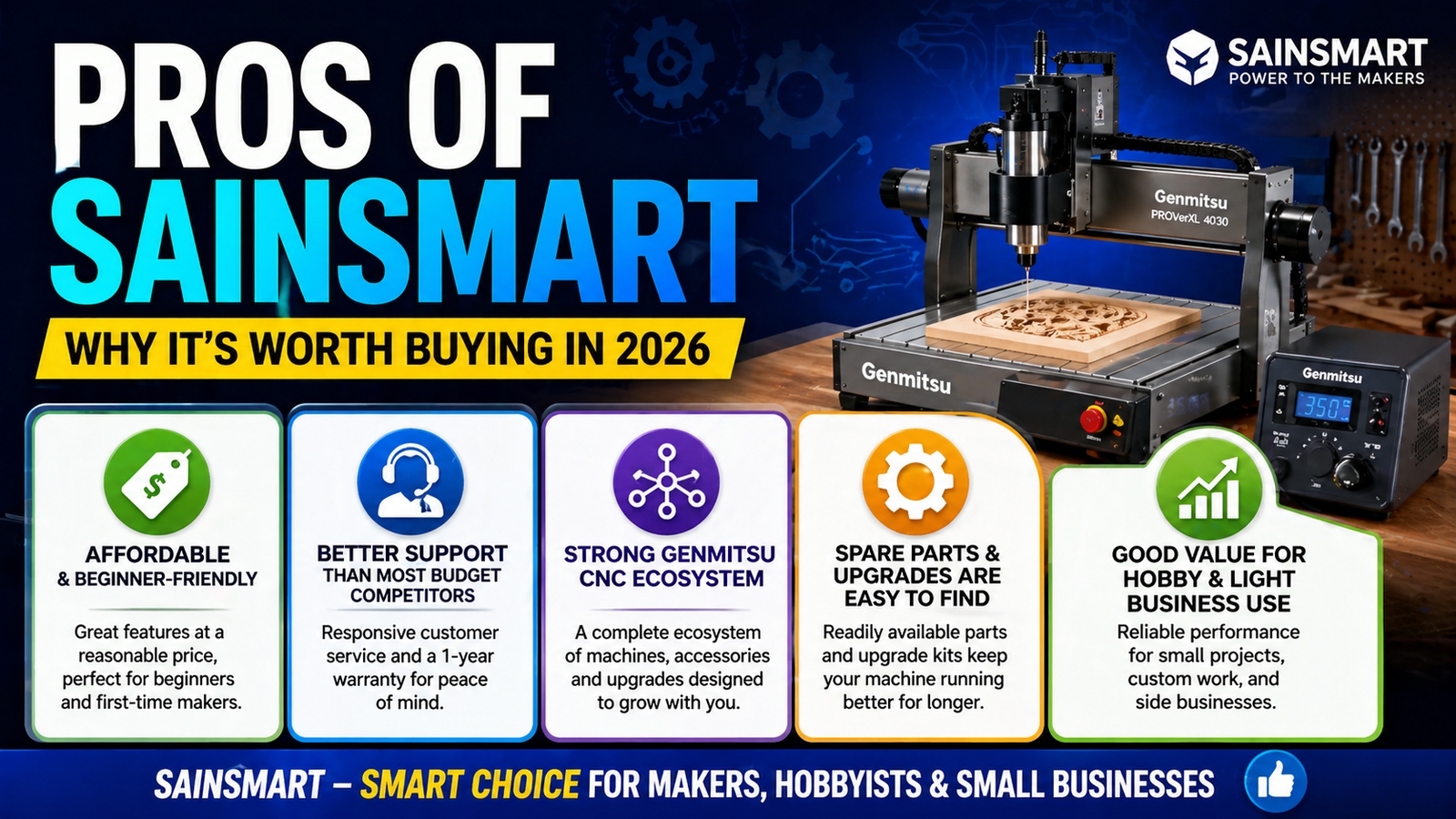
Pros
- Affordable and beginner-friendly
- Better support than most budget competitors
- Strong Genmitsu CNC ecosystem
- Spare parts and upgrades are easy to find
- Good value for hobby and light business use
Cons
- Not built for industrial production
- Entry-level models have limited cutting power
- Some users will outgrow smaller machines quickly
- Advanced metal work requires patience and upgrades
Who Should Buy SainSmart in 2026?
Not every tool brand is built for every type of buyer, and that is exactly why SainSmart works so well for the audience it targets. If you are a beginner stepping into CNC for the first time, SainSmart is one of the easiest entry points in 2026. The machines are beginner-friendly, the learning curve is manageable, and the brand has enough documentation and community support to help you avoid feeling lost during setup. For students, hobbyists, and first-time makers, that makes a huge difference because the goal is not just buying a machine—it is actually learning how to use it without giving up halfway through.
SainSmart is also a smart fit for side hustlers and small business owners who need practical tools without taking on a huge upfront cost. If you sell custom signs, engraved gifts, small wood products, or personalized accessories, SainSmart gives you a realistic way to start production without spending thousands on industrial equipment. That makes it especially attractive for Etsy sellers, craft businesses, and creators testing product ideas. It is the kind of brand that helps people start small, learn fast, and scale when needed.
Who Should Avoid SainSmart?
SainSmart is not the right fit for every buyer, and being honest about that makes this review more useful. If you need industrial-grade speed, heavy-duty cutting power, or a machine that can run all day in a commercial production environment, SainSmart will probably feel too limited. Its machines are designed for hobby work, light production, and maker-focused projects—not full-scale manufacturing. Buyers expecting industrial performance from a desktop-priced machine are usually the ones who end up disappointed.
It is also not the best option for advanced machinists who already know they need higher rigidity, faster cutting speeds, and more aggressive metal-working capability. SainSmart can handle light aluminum work, but it is not built for serious metal fabrication. If your projects regularly involve hard metals, long production cycles, or demanding commercial workloads, investing in a more industrial CNC brand will make more sense in the long run.
Also Read
K&F Concept Review 2026: Are K&F Concept Products Worth Buying?
Perk Clothing Review: Style, Pricing & Quality
Credit Glory Review: Does It Really Improve Your Score?
Holden Brand Review: Is Holden Worth Your Investment?
Maxiscoot Review 2026: Best Store for Scooter Parts?
SainSmart vs Other Budget CNC Brands
One of the biggest reasons buyers choose SainSmart over other budget CNC brands is trust. The lower end of the CNC market is crowded with machines that look similar on paper but feel very different in real-world use. Many no-name brands offer nearly identical specs at lower prices, but that often comes with trade-offs like weak frames, poor documentation, inconsistent quality control, and almost no customer support. That is where SainSmart usually justifies its slightly higher price.
SainSmart’s advantage is not that it is dramatically more powerful than every cheap competitor. Its advantage is that it is usually more polished. Assembly is easier, documentation is clearer, spare parts are easier to find, and the overall user experience is much less frustrating. That may not sound exciting, but for beginners and casual makers, it is often the difference between enjoying the machine and abandoning it after a few failed attempts.
SainSmart Software Compatibility
Hardware is only half the story with CNC and laser tools. Software matters just as much, and this is another area where SainSmart performs well enough for most buyers. SainSmart machines are generally compatible with widely used CAD/CAM and control software, which makes them much easier to integrate into a normal workflow. That includes beginner-friendly software options as well as more advanced tools for users who want better control and deeper customization.
This compatibility matters because it gives users flexibility. You are not locked into some obscure software ecosystem that becomes a headache later. Beginners can start with simple tools and basic workflows, then move into more advanced software as their skills improve. That kind of flexibility makes SainSmart easier to grow with, especially for users who plan to treat their first machine as a long-term learning platform.
Is SainSmart Worth Buying in 2026?
Yes—SainSmart is worth buying in 2026 if you are the kind of buyer it was built for. That means hobbyists, makers, students, educators, side hustlers, and small shops that need practical tools without industrial pricing. SainSmart is not the cheapest option on the market, and that is actually one of its strengths. It usually costs a little more than the sketchy clone brands, but that extra cost often buys better engineering, better support, and fewer headaches.
If your goal is learning CNC, running light production, building prototypes, engraving custom products, or growing a small maker business, SainSmart is one of the safer buys in its category. If your goal is industrial throughput or aggressive metal machining, look elsewhere. For everyone else, SainSmart earns its place.
Conclusion
SainSmart has stayed relevant in 2026 because it understands what most buyers actually need: approachable tools, realistic pricing, decent build quality, and enough support to keep moving when things go wrong. That combination is harder to find than it should be. Plenty of brands can be cheaper. Plenty can be stronger. Very few balance affordability, usability, and ecosystem support as well as SainSmart does.
SainSmart is not perfect, but it does not need to be. It just needs to be dependable, practical, and worth the money for the audience it serves. In that role, it delivers.
Frequently Asked Questions
Yes, SainSmart remains a solid brand in 2026 for hobbyists, makers, and small workshop users. It is especially well known for affordable desktop CNC machines, maker tools, and reliable upgrade paths.
In most cases, yes. SainSmart usually offers better build quality, stronger support, easier upgrades, and a more reliable parts ecosystem than no-name clone brands.
Yes. SainSmart is one of the better beginner-friendly brands in the desktop CNC and maker space because its machines are easier to assemble, easier to learn, and backed by stronger support.
Some can, especially mid-range and upgraded models, but they are best suited for light aluminum work rather than aggressive machining. Setup and tooling matter a lot.
Compared with many budget competitors, yes. SainSmart offers a 1-year warranty, spare parts, documentation, and a strong user community that makes troubleshooting much easier.
Table of Contents
Related Post

Finding Student Housing and Communities With Erasmusu: A Practical Guide
admin
September 19, 2026
Read More »

What Travelers Should Know About Iberostar (closed) and Its Hotel History
admin
September 18, 2026
Read More »

Planning a European Trip? Discover the Benefits of Direct Ferries
admin
September 17, 2026
Read More »

What Makes Der Gepflegte Mann a Notable Name in Men’s Personal Care
admin
September 16, 2026
Read More »