

Comparexpert
Comparison Between Company


Hapbee Review: Can This Wellness Technology Improve Your Mood?
Explore this in-depth Hapbee review to discover how this innovative wellness technology claims to improve mood, enhance focus, and support better sleep without chemicals. Learn how Hapbee works, its benefits, pros and cons, and whether it’s truly worth your investment.
Table of Contents
What Is Hapbee?
Overview of Hapbee Technology
Imagine if you could press a button and instantly feel calm, focused, or energized—without coffee, pills, or supplements. Sounds futuristic, right? That’s exactly what Hapbee claims to offer. It’s a wearable wellness device designed to influence your mood using ultra-low frequency electromagnetic signals. Unlike traditional wellness tools that rely on ingestion—like caffeine or melatonin—Hapbee takes a completely different route by working externally on your body.
At its core, Hapbee is built on a concept called bio-streaming, where specific frequencies mimic the effects of compounds such as caffeine, CBD, or melatonin. Instead of consuming these substances, your body “interprets” the signals in a similar way. The idea is both fascinating and controversial, which is why it has gained attention in the biohacking and wellness communities.
The company positions Hapbee as a next-generation wellness technology that helps improve mood, sleep, focus, and energy—all without chemicals entering your system. It’s marketed especially to people who want natural alternatives to stimulants or sleep aids. But the big question remains: does it actually work in real life, or is it just clever marketing wrapped in science-sounding language?
Types of Hapbee Devices
Hapbee offers two main types of devices, each designed for different use cases. The most popular one is the Hapbee Neckband, which sits comfortably around your neck like a lightweight pair of headphones. This device is meant for everyday use—whether you’re working, relaxing, or trying to stay focused during long hours.
The second option is the Hapbee Smart Sleep Pad, which is specifically designed to improve sleep. You place it under your pillow or mattress, and it emits signals while you sleep. According to claims, it can help users fall asleep faster and achieve deeper sleep cycles.
Both devices connect to a mobile app where you can choose different “modes” or “blends.” These blends correspond to different emotional or physical states like calmness, focus, relaxation, or energy. This dual-device approach makes Hapbee flexible, allowing users to target both daytime productivity and nighttime recovery.
How Does Hapbee Work?
Science Behind Frequency Technology
Let’s break this down in simple terms. Hapbee uses ultra-low radiofrequency energy (ulRFE) to send signals to your body. These signals are designed to mimic the electromagnetic patterns associated with certain compounds—like caffeine for energy or melatonin for sleep.
Now, here’s where things get interesting. Your body naturally responds to electrical signals at a cellular level. In fact, bioelectric medicine is an emerging field that explores how electrical stimulation can influence biological processes. Hapbee taps into this idea by delivering extremely low-energy signals that are weaker than those from a typical smartphone.
But let’s be real for a second—this isn’t mainstream science yet. While the concept is intriguing, the amount of large-scale, peer-reviewed research specifically validating Hapbee’s effectiveness is still limited. Some experts even point out that similar technologies in sleep and brain stimulation have shown mixed results in studies.
So, while the mechanism is scientifically plausible, it’s not universally accepted. That doesn’t mean it doesn’t work—it just means the science is still catching up with the product.
What Are “Blends” or Signals?
The real magic of Hapbee lies in its “Blends”—pre-programmed signal combinations designed to create specific effects. Think of these as digital versions of substances like caffeine, nicotine, CBD, or melatonin.
For example:
- Want to feel alert? Choose the Focus blend
- Need to relax? Try the Calm blend
- Struggling to sleep? Use the Sleep blend
These blends are delivered through the device and controlled via the app. According to the company, users can switch between different states instantly, making it feel like a “remote control for your mood.”
It sounds almost too good to be true—and honestly, that’s exactly why people are both excited and skeptical about it.
Key Features of Hapbee
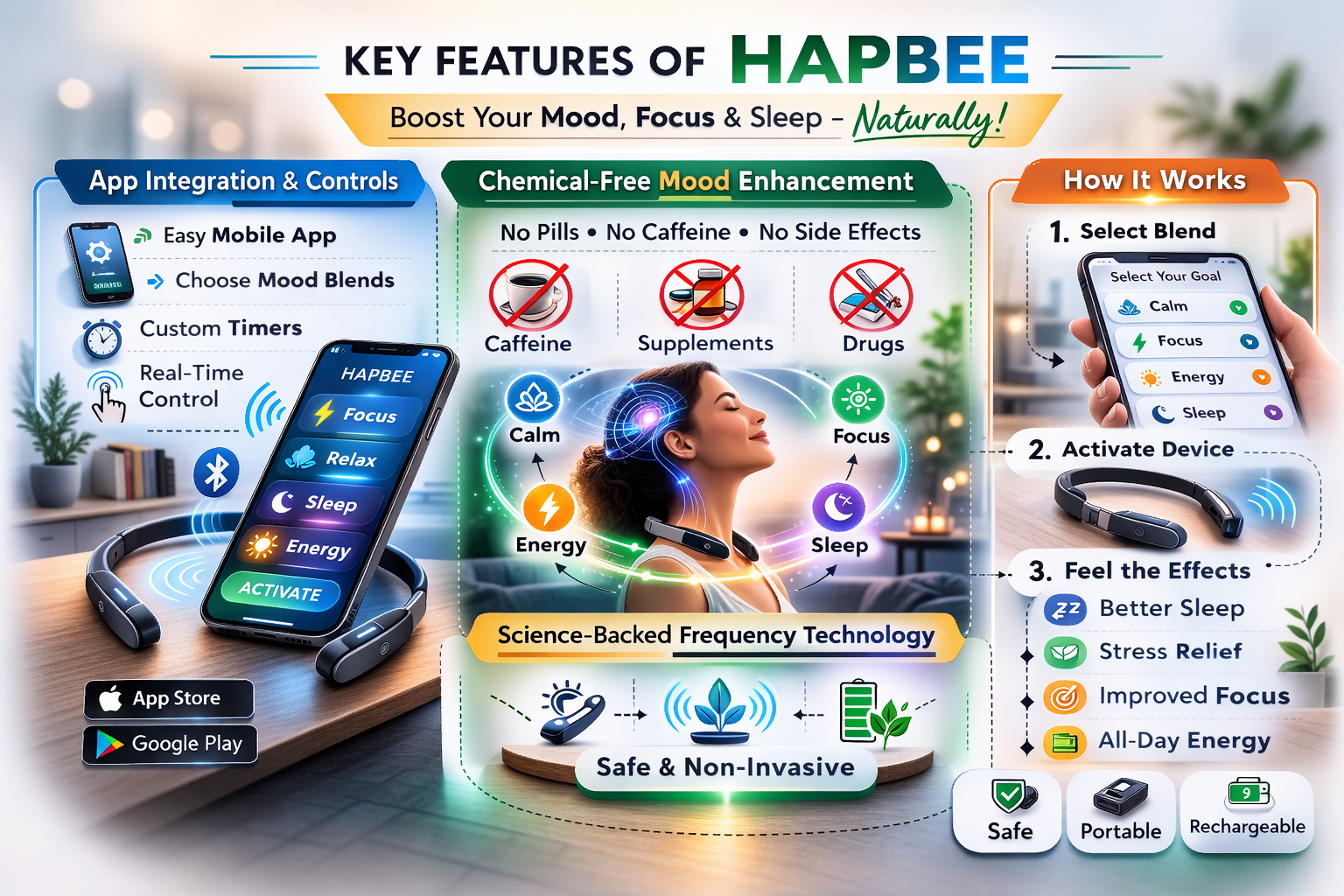
App Integration and Controls
One of the standout features of Hapbee is its mobile app integration. The app acts as the control center, allowing you to select your desired mood state and adjust session duration. This makes the device incredibly user-friendly, even for beginners.
The interface is clean and intuitive, with options categorized based on outcomes like sleep, focus, relaxation, and energy. You can even customize sessions based on how long you want the effect to last. This level of control is something most wellness devices don’t offer.
Another interesting aspect is the continuous expansion of blends. Over time, Hapbee adds new signal profiles, giving users more options to experiment with. It’s almost like upgrading your emotional toolkit through software updates.
Chemical-Free Mood Enhancement
Here’s the biggest selling point: no chemicals, no ingestion, no side effects—at least in theory. Hapbee claims to provide the benefits of substances like caffeine or melatonin without actually putting anything into your body.
For people who are sensitive to stimulants or want to avoid dependency, this is a huge advantage. You don’t have to worry about caffeine crashes, melatonin grogginess, or supplement tolerance.
However, it’s important to keep expectations realistic. The effects are often described as subtle rather than dramatic, which might actually be a good thing if you’re looking for gentle support instead of a strong impact.
Benefits of Using Hapbee
Improved Sleep Quality
Sleep is where Hapbee seems to shine the most. Many users report falling asleep faster and experiencing deeper sleep cycles. Some claims even suggest up to 48% improvement in sleep quality, although these figures should be taken with caution.
The idea of improving sleep without pills is incredibly appealing. Instead of relying on melatonin supplements, you can simply activate a sleep blend and let the device do its thing.
Better sleep doesn’t just mean feeling rested—it also impacts mood, productivity, and overall health. If Hapbee can consistently improve sleep, that alone could justify its cost for many users.
Better Focus and Productivity
Another major benefit is improved focus. Users often compare the effect to a mild caffeine boost—enough to stay alert without feeling jittery.
This can be especially useful for students, professionals, or anyone working long hours. Imagine being able to switch into “deep work mode” without reaching for another cup of coffee.
That said, the effectiveness varies from person to person. Some people notice a clear difference, while others describe the effect as minimal.
Stress Reduction
Stress is a modern epidemic, and Hapbee aims to tackle it with calming blends. These are designed to mimic the effects of relaxing compounds like CBD or alcohol—without the downsides.
Users often report feeling more relaxed and less anxious after using these modes. It’s not a miracle cure, but it can be a helpful tool for managing daily stress.
Think of it like background support—it won’t eliminate stress completely, but it might make it easier to handle.
Real User Reviews and Experiences
Positive Feedback
Many users describe Hapbee as a game-changer for sleep and energy levels. Some report waking up feeling refreshed for the first time in years, while others say it helps them stay consistent with their sleep routines.
There’s also praise for its convenience. Unlike supplements, there’s no need to plan intake—you just activate the device whenever needed.
Criticism and Concerns
On the flip side, skepticism is common. Some reviewers mention that the effects are too subtle or inconsistent. Others question the lack of strong scientific evidence supporting the claims.
Customer service and pricing are also occasional concerns, which is something to keep in mind before buying.
Hapbee Pros and Cons
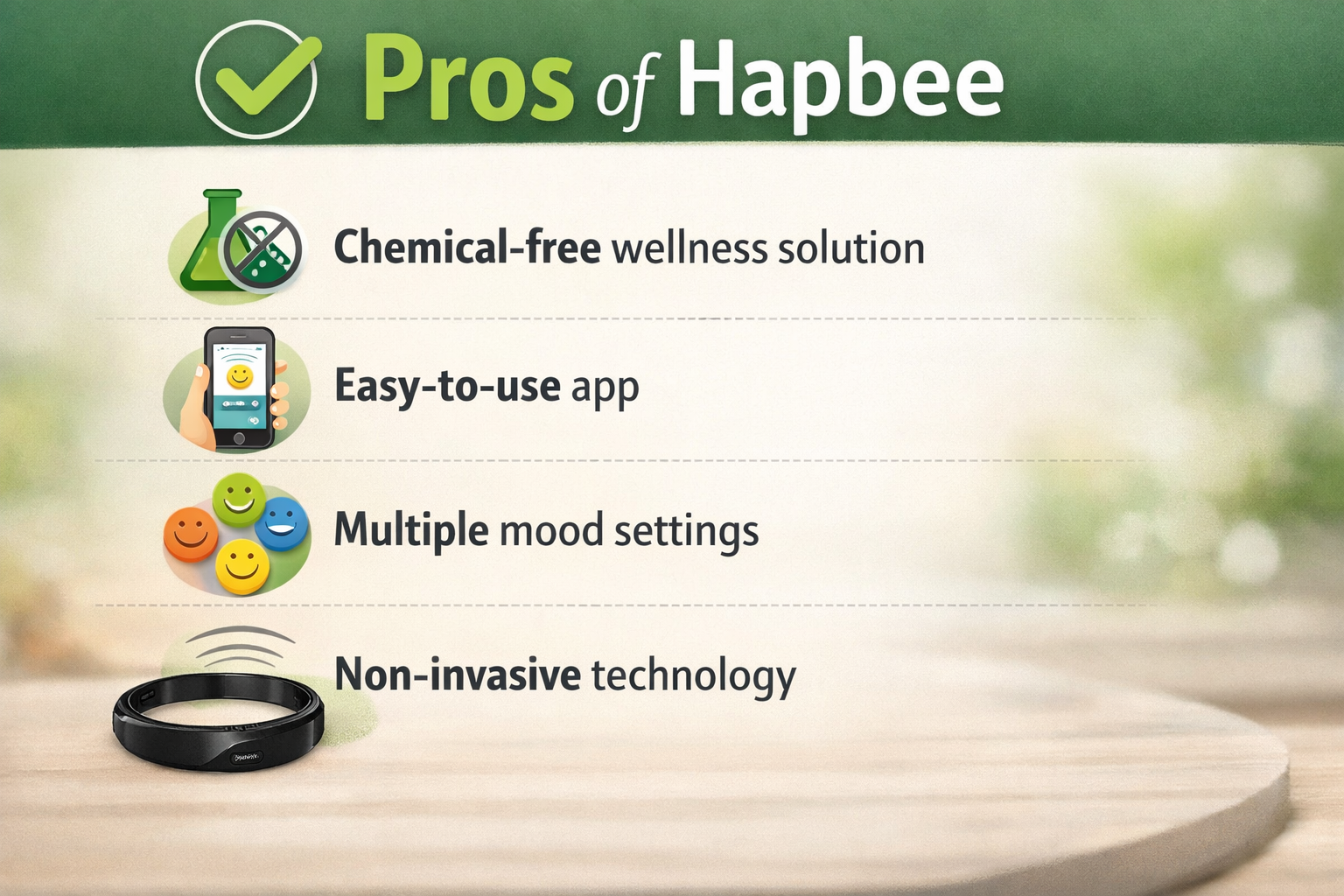
Pros
- Chemical-free wellness solution
- Easy-to-use app
- Multiple mood settings
- Non-invasive technology
Cons
- Limited scientific validation
- Expensive pricing
- Effects can be subtle
- Not suitable for everyone
Is Hapbee Scientifically Proven?
This is where things get tricky. While Hapbee is based on real scientific concepts like electromagnetic signaling, large-scale clinical validation is still limited.
Experts in sleep and brain stimulation technologies often emphasize that results can vary widely and that more research is needed.
So, think of Hapbee as an experimental wellness tool rather than a medically proven solution.
Pricing and Value for Money
Hapbee is not cheap—it’s positioned as a premium wellness device. While the upfront cost might feel high, the long-term value depends on how much you use it.
If it replaces caffeine, sleep aids, or stress-relief tools, it could actually save money over time. But if the effects don’t work for you, it might feel like an expensive experiment.
Also Read
Truly Beauty Review: Is This Skincare Brand Worth the Hype?
Online NL: Complete Guide to Digital Services in the Netherlands
Parcel ABC UK Review: Shipping Services, Pricing, and Delivery Speed
Top 10 Reasons WP Engine Boosts Website Speed and SEO Performance
How ConvertKit(Kit) Empowers Creators with Seamless Email Marketing
Who Should Use Hapbee?
Hapbee is ideal for:
- Biohackers and tech enthusiasts
- People sensitive to caffeine or supplements
- Individuals struggling with sleep or stress
It’s not recommended for those expecting instant, dramatic results.
Final Verdict: Is Hapbee Worth It?
Hapbee sits in a unique space between science and innovation. It’s not a miracle device, but it’s definitely not a gimmick either. The truth lies somewhere in between.
If you’re open to experimenting with new wellness technologies and don’t mind subtle effects, Hapbee could be worth trying. But if you’re looking for guaranteed results backed by strong scientific evidence, you might want to wait for more research.
Conclusion
Hapbee is one of the most intriguing wellness devices on the market today. It challenges the traditional way we think about mood, energy, and sleep by offering a completely non-chemical approach. While the science behind it is still evolving, the concept itself is undeniably fascinating.
At the end of the day, Hapbee is less about instant transformation and more about gradual improvement. If you approach it with realistic expectations, it might just become a valuable addition to your wellness routine.
Frequently Asked Questions
It works for some users, especially for sleep and relaxation, but results vary widely.
Yes, it uses very low-energy signals and is generally considered safe for most adults.
It may mimic their effects, but not as strongly as actual substances.
Some users feel effects immediately, while others need consistent use.
It depends on your expectations—great for experimentation, but not guaranteed.
Table of Contents
Related Post




Parcel ABC UK Review: Shipping Services, Pricing, and Delivery Speed
admin
March 13, 2026
Read More »