
Comparexpert
Comparison Between Company


MMOGA DE vs Other Key Resellers: Which Platform Offers Better Deals?
This blog post explores a detailed comparison between MMOGA DE and other leading game key resellers such as G2A, Kinguin, CDKeys, and Eneba. It breaks down pricing, safety, legitimacy, and buyer protection to help gamers understand which platform truly offers the best deals in 2026. If you’re looking to save money on digital game purchases while balancing risk and reliability, this guide gives a clear breakdown of where MMOGA DE stands in the competitive gaming marketplace.
Table of Contents
Introduction to Game Key Reselling Market
The digital gaming world has changed dramatically over the past decade, and one of the biggest disruptions has been the rise of game key resellers. Instead of buying directly from Steam, PlayStation Store, or Xbox Store, millions of gamers now turn to third-party platforms that promise the same games at heavily discounted prices. This shift has created a massive global grey market where platforms like MMOGA DE, G2A, Kinguin, CDKeys, and Eneba compete aggressively on pricing.
At first glance, it almost feels like a cheat code for gaming. Why pay full price when the same game appears for 30%–80% less? But the reality behind these discounts is more complex than it looks. Many of these platforms operate as marketplaces where independent sellers list keys sourced from regional pricing differences, bundle deals, or wholesale purchases. Some platforms are more controlled and direct, while others function like open marketplaces similar to eBay.
Understanding how these platforms work is essential before deciding where to spend your money. While savings can be significant, there are trade-offs in terms of risk, legitimacy, refund policies, and seller transparency. That’s exactly where the comparison between MMOGA DE and other major key resellers becomes important.
How MMOGA DE Works in 2026
Marketplace vs direct reseller model
MMOGA DE is one of the older digital key platforms in Europe, often positioned as a hybrid between a reseller and marketplace. Unlike fully open marketplaces such as G2A or Kinguin, MMOGA typically acts more like a controlled reseller with curated listings. This means users are less likely to deal directly with random third-party sellers, which reduces some of the unpredictability.
However, it still operates in the grey-market ecosystem. That means MMOGA does not always source keys directly from publishers. Instead, it relies on bulk purchases, regional pricing differences, and distributor channels that are not always fully transparent. This structure places MMOGA somewhere between fully authorized retailers and open marketplaces.
Pricing strategy and regional sourcing
The main appeal of MMOGA DE is its aggressive pricing strategy. Games are often listed below official store prices due to regional arbitrage and bulk purchasing. In many cases, prices may match or slightly undercut competitors like CDKeys or Eneba, especially for older AAA titles.
However, pricing consistency can vary. Some games are heavily discounted, while newer releases may not always offer significant savings compared to official platforms during sales. The platform benefits from European market positioning, which allows it to adjust prices based on regional demand and publisher pricing differences.
Major Competitors of MMOGA DE
To understand whether MMOGA DE offers the best deals, we need to compare it with the biggest players in the market.
G2A overview
G2A is one of the largest and most controversial game key marketplaces. It functions like a massive open marketplace where thousands of sellers list keys. According to industry analysis, G2A offers extremely competitive pricing due to seller competition, but the platform has historically faced concerns about grey-market sourcing and inconsistent seller reliability .
Its biggest strength is scale. Its biggest weakness is trust variance between sellers.
Kinguin overview
Kinguin operates similarly to G2A as a peer-to-peer marketplace. It is known for wide selection and competitive pricing. However, like G2A, it depends heavily on seller integrity, which introduces variability in key reliability and customer experience.
CDKeys overview
Unlike marketplace-based platforms, CDKeys (now operating under a more controlled reseller model) is considered closer to a direct retailer. It typically sources keys in bulk and resells them directly. This reduces uncertainty and makes it one of the more stable options in terms of legitimacy and user experience.
Eneba overview
Eneba is a fast-growing marketplace with a mix of direct listings and third-party sellers. It has gained popularity due to competitive pricing and relatively strong buyer protection policies compared to older marketplaces. Industry reviews highlight its balance between affordability and safer transactions compared to G2A-style platforms.
Key Features of “MMOGA DE vs Other Key Resellers
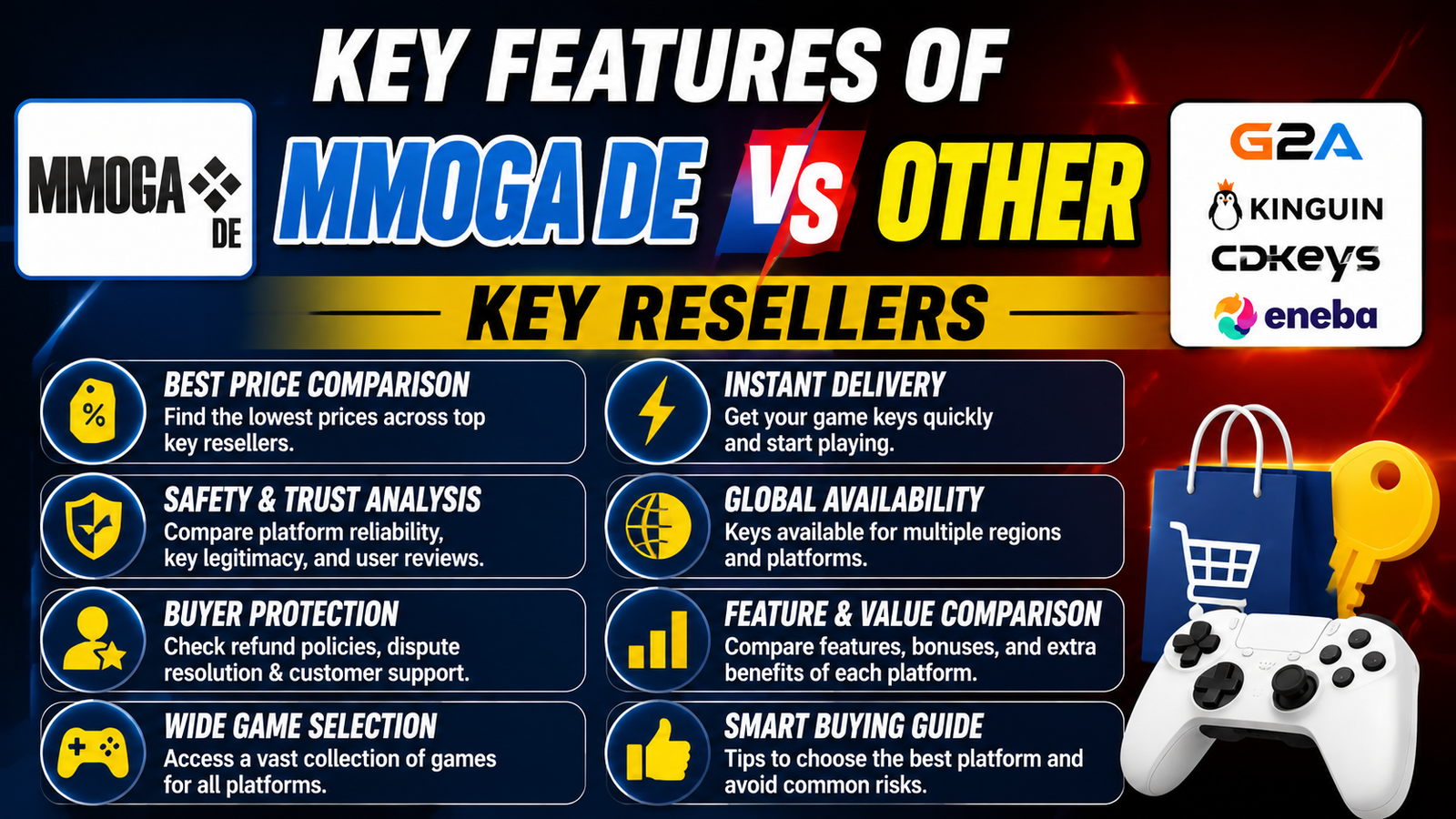
When you read this article on “MMOGA DE vs Other Key Resellers: Which Platform Offers Better Deals?”, you get a complete guide designed to help you make smarter buying decisions in the gaming market. The main goal is to break down complex reseller platforms into simple insights that anyone can understand.
This blog focuses on delivering a clear and practical comparison between MMOGA DE and popular alternatives like G2A, Kinguin, CDKeys, and Eneba. Instead of confusing technical terms, everything is explained in a simple, reader-friendly way so you can quickly understand where the best deals actually come from.
It also provides a deep pricing analysis, showing how discounts vary across platforms and why some websites offer cheaper game keys than others. Along with pricing, the article highlights important factors like trust level, refund policies, and buyer protection, which are often ignored but very important when buying digital keys.
Pricing Comparison Across Platforms
Pricing is where things get interesting. While all these platforms advertise discounts, real-world prices vary depending on game popularity, region, and seller availability.
Platform | Typical Discount Range | Pricing Stability | Best For |
MMOGA DE | 10%–60% | Medium | European users, older games |
G2A | 20%–80% | Low–Medium | Maximum price competition |
Kinguin | 15%–70% | Medium | Variety + occasional deals |
CDKeys | 10%–55% | High | Reliable consistent pricing |
Eneba | 15%–75% | Medium–High | Balanced deals + protection |
From a pure pricing standpoint, G2A often wins the lowest possible price, but it comes with inconsistency. MMOGA DE typically sits in the middle—rarely the absolute cheapest, but also not the riskiest. CDKeys tends to be more stable but slightly less aggressive in discounting.
The key takeaway is simple: the cheapest option is not always the best deal if the risk factor is high.
Safety, Legitimacy, and Buyer Protection
Grey-market risks explained
The entire ecosystem of key resellers exists in what is often called the grey market. According to industry analysis, keys may originate from regional price differences, bundle resales, or in some cases questionable sourcing methods. This creates a risk that a purchased key might later be revoked by publishers if it violates distribution rules or was obtained improperly .
Platforms like G2A and Kinguin are particularly known for this marketplace-style risk because they allow third-party sellers to operate freely. CDKeys and MMOGA DE reduce this risk by being more controlled, but they do not eliminate it entirely.
Refund and dispute systems
Buyer protection varies significantly:
- MMOGA DE: Moderate refund support, slower dispute handling
- G2A: Optional paid protection system in some cases
- Kinguin: Similar marketplace dispute resolution system
- CDKeys: More direct refund system due to controlled sourcing
- Eneba: Free buyer protection and structured dispute handling
From a safety perspective, CDKeys and Eneba generally offer more predictable user protection, while MMOGA DE sits in the middle tier.
How Game Key Reseller Platforms Actually Work
To understand whether MMOGA DE or any other platform offers better deals, it is important to know how these websites actually operate behind the scenes. Game key resellers usually do not publish games themselves. Instead, they act as intermediaries between buyers and various global sources of game keys.
Some platforms purchase keys in bulk from regions where prices are lower due to regional pricing strategies. Others rely on bundle deals, promotional offers, or wholesale distributors. These keys are then resold to users at a slightly higher price while still keeping it cheaper than official stores like Steam or Epic Games.
However, not all platforms follow the same model. Some, like CDKeys, operate more like controlled resellers with limited sellers, while marketplaces like G2A and Kinguin allow thousands of third-party sellers. This difference directly impacts pricing, safety, and consistency.
Why MMOGA DE Is Popular Among European Gamers
MMOGA DE has built a strong reputation, especially in the European gaming community. One of the biggest reasons for its popularity is its long presence in the market. Over time, it has developed a more structured and semi-controlled selling system compared to open marketplaces.
Another reason is regional pricing advantage. Many deals on MMOGA DE are optimized for European users, making it a preferred option for PC gamers looking for consistent discounts without too much risk.
Additionally, the platform offers a straightforward buying experience, which is especially helpful for users who do not want to deal with multiple sellers or complicated dispute systems.
Risks You Should Know Before Buying Game Keys
Even though these platforms offer attractive discounts, there are certain risks involved that every buyer should understand before making a purchase.
One of the biggest concerns is key revocation, where a game key may stop working if it was sourced improperly or flagged by the publisher. This does not happen often, but it is a known risk in grey-market platforms.
Another issue is seller inconsistency. On open marketplaces, the quality of service depends heavily on individual sellers, which means two users can have completely different experiences on the same platform.
The Role of Trust in Game Key Reseller Platforms
When comparing MMOGA DE vs other key resellers, trust becomes one of the most important factors after price. Many users focus only on discounts, but experienced gamers know that trust determines whether a purchase is actually worth it.
Trust in a game key platform depends on several elements such as seller verification, refund reliability, customer support response time, and key authenticity. Platforms like CDKeys are known for their controlled environment, which naturally increases trust. On the other hand, marketplaces like G2A and Kinguin rely heavily on third-party sellers, which can sometimes lead to inconsistent user experiences.
MMOGA DE stands in the middle of this spectrum. It is more structured than open marketplaces but still operates in a semi-grey market environment. This makes it reasonably safe for most users, but not completely risk-free.
Why Some Game Keys Are Extremely Cheap
One of the biggest questions gamers ask is why some platforms offer prices that seem “too good to be true.” The answer lies in the global pricing structure of digital games.
Game publishers often adjust prices based on country income levels. For example, a game may cost significantly less in certain regions compared to the US or Western Europe. Sellers take advantage of these regional differences by purchasing keys in cheaper regions and reselling them globally.
Another reason is bundle redistribution. Many game keys come from discounted bundles or promotional events. These keys are later separated and sold individually at lower prices.
Pros and Cons of MMOGA DE vs Competitors
MMOGA DE strengths and weaknesses
MMOGA DE has remained relevant for years because it balances pricing and stability reasonably well.
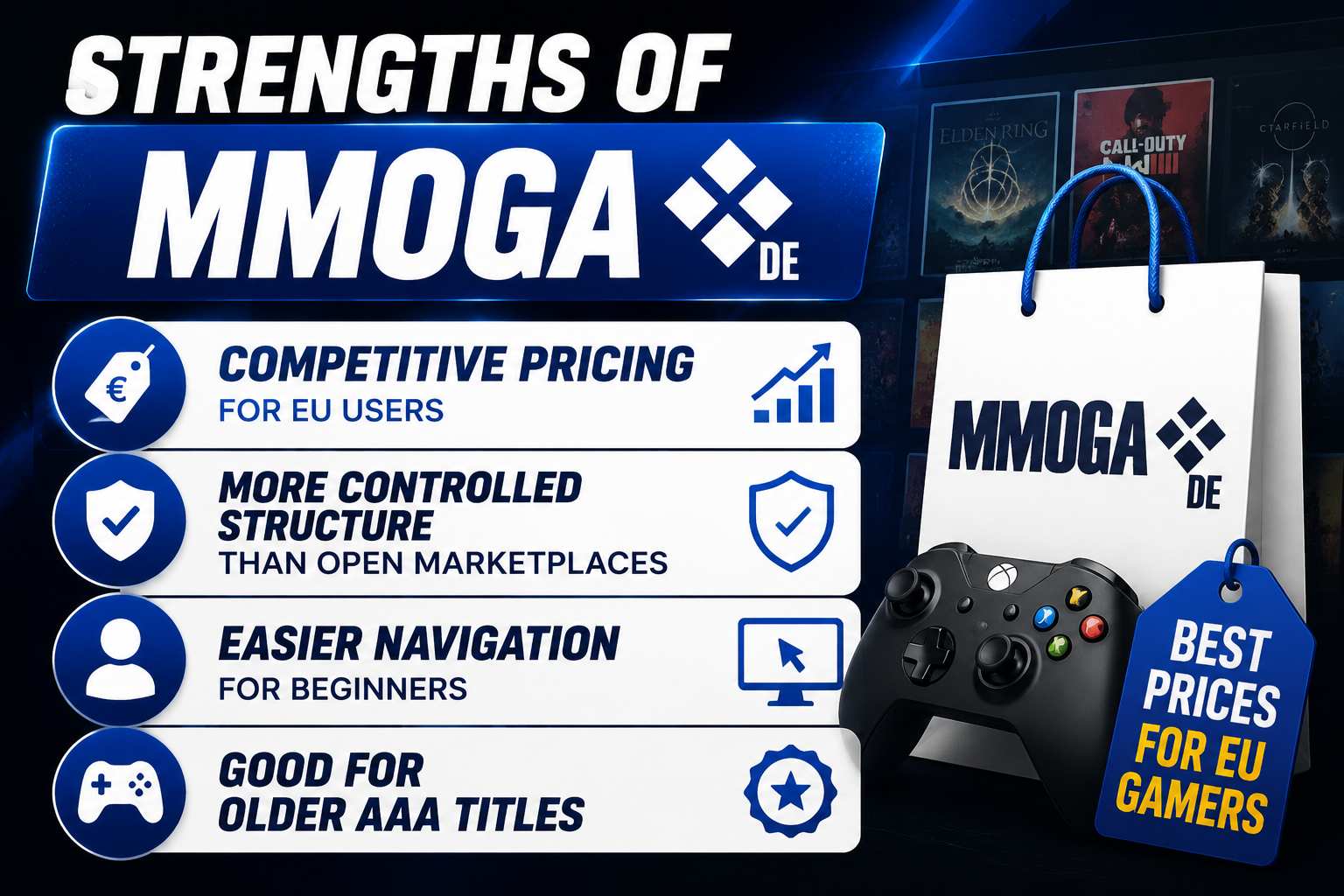
Strengths:
- Competitive pricing for EU users
- More controlled structure than open marketplaces
- Easier navigation for beginners
- Good for older AAA titles
Weaknesses:
- Not always the cheapest option
- Limited transparency on key sourcing
- Refund process not as strong as CDKeys or Eneba
- Less global reach compared to G2A
Compared to competitors, MMOGA DE is best described as a middle-ground platform—safer than open marketplaces but less optimized than modern competitors.
Which Platform Offers the Best Deals Overall?
If your only goal is the lowest possible price, then platforms like G2A and Eneba often win due to intense seller competition and dynamic pricing. However, this comes with variability in trust and refund reliability.
If your goal is safe and consistent savings, then CDKeys stands out as the most stable option, even if it is not always the cheapest.
MMOGA DE falls into a strategic middle zone. It is:
- Safer than G2A/Kinguin
- Less aggressive than Eneba
- More EU-focused than CDKeys
So the answer depends on what “best deal” means to you. If it means raw price, MMOGA DE is not always the leader. If it means balanced value with moderate risk, it becomes a strong contender.
Hidden Costs and What Buyers Should Watch Out For
Even though game key resellers advertise huge discounts, there can be hidden factors that affect the final value of your purchase.
One such factor is activation restrictions. Some game keys are region-locked, meaning they can only be activated in specific countries. If a user does not check this properly, the key may become useless.
Another issue is extra service fees. While the game price may look cheap, some platforms add optional fees for faster delivery, buyer protection, or premium support services.
There is also the possibility of account restrictions in rare cases where publishers detect unauthorized key sourcing. While this is not common, it is still something buyers should be aware of when purchasing from grey-market platforms.
Also Read
Monito Review 2026: Features, Benefits, and Everything You Need to Know
How to Join the smava Kreditpartnerprogramm DE and Maximize Your Earnings
How Booking.com North America Simplifies Travel Planning
NordVPN DE: The Complete Guide to Secure and Private Internet Browsing
What Is KnownHost, LLC? A Complete Guide to Managed Hosting Services
User Experience Comparison Across Platforms
User experience is another key factor when evaluating MMOGA DE vs other key resellers. A smooth and simple buying process often makes a big difference for users.
Platforms like CDKeys offer a very clean and straightforward checkout experience with minimal steps. Eneba also provides a modern interface with filters, ratings, and buyer protection indicators that make decision-making easier.
In comparison, G2A and Kinguin offer a more marketplace-style experience, which can feel overwhelming for beginners due to the large number of sellers and listing variations.
MMOGA DE provides a relatively simple structure, which makes it easier for users who prefer a no-frills purchasing experience without too many distractions or seller comparisons.
Expert Buying Tips for Safe Key Purchases
Before buying from any key reseller, it’s important to think like a smart buyer rather than a bargain hunter. The grey market is full of opportunities, but also hidden risks.
- Always compare prices across at least 3 platforms
- Prefer sellers with high ratings and transaction history
- Avoid extremely low prices that look unrealistic
- Use PayPal or protected payment methods when possible
- Check region restrictions carefully before purchasing
- Stick to trusted platforms for newer AAA releases
Think of it like buying electronics from multiple vendors—you want the best price, but also a warranty that actually works when something goes wrong.
The Future of Game Key Reseller Platforms
The game key resale industry is continuously evolving. With increasing scrutiny from publishers and stricter digital distribution rules, platforms are being forced to improve transparency and buyer protection.
In the future, we may see more platforms moving toward fully authorized reseller partnerships, reducing grey-market risks. Some companies are already shifting in this direction by working directly with publishers or verified distributors.
At the same time, competition among platforms like MMOGA DE, Eneba, CDKeys, and others will continue to push prices lower, benefiting consumers.
However, users should expect tighter restrictions on certain games and regions as publishers try to control distribution more strictly.
Conclusion
The comparison between MMOGA DE and other key resellers shows that no single platform dominates in every category. Instead, each platform occupies a specific position in the ecosystem. MMOGA DE offers a balanced experience with moderate pricing and relatively controlled listings, while platforms like G2A push extreme pricing at the cost of higher risk. CDKeys focuses on reliability, and Eneba tries to combine competitive pricing with stronger buyer protection.
If your priority is maximum discount hunting, MMOGA DE is not always the leader. But if you want a safer middle-ground option with decent pricing stability, it remains a solid choice in 2026’s competitive game key market.
Frequently Asked Questions
MMOGA DE is generally considered moderately safe, but like all grey-market platforms, it carries some risk depending on key sourcing and game publisher policies.
Prices are lower due to regional pricing differences, bulk purchasing, and third-party reselling strategies rather than direct publisher pricing.
G2A often has lower prices due to heavy seller competition, but MMOGA DE provides more stability in pricing and seller control.
Yes, in rare cases publishers may revoke keys if they were sourced in violation of distribution rules or purchased through fraudulent means.
CDKeys and Eneba are generally considered more stable and safer due to controlled sourcing and better buyer protection systems.
Table of Contents
Related Post
A Beginner’s Guide to Tally for Accounting, Inventory, and Business Management
admin
October 12, 2026
Read More »

Expert Tips for Savvy Car Insurance Savings When Comparing Insurance Policies
admin
October 11, 2026
Read More »

How to Choose the Right Coverage With Pets Best Pet Insurance for Your Pet
admin
October 10, 2026
Read More »